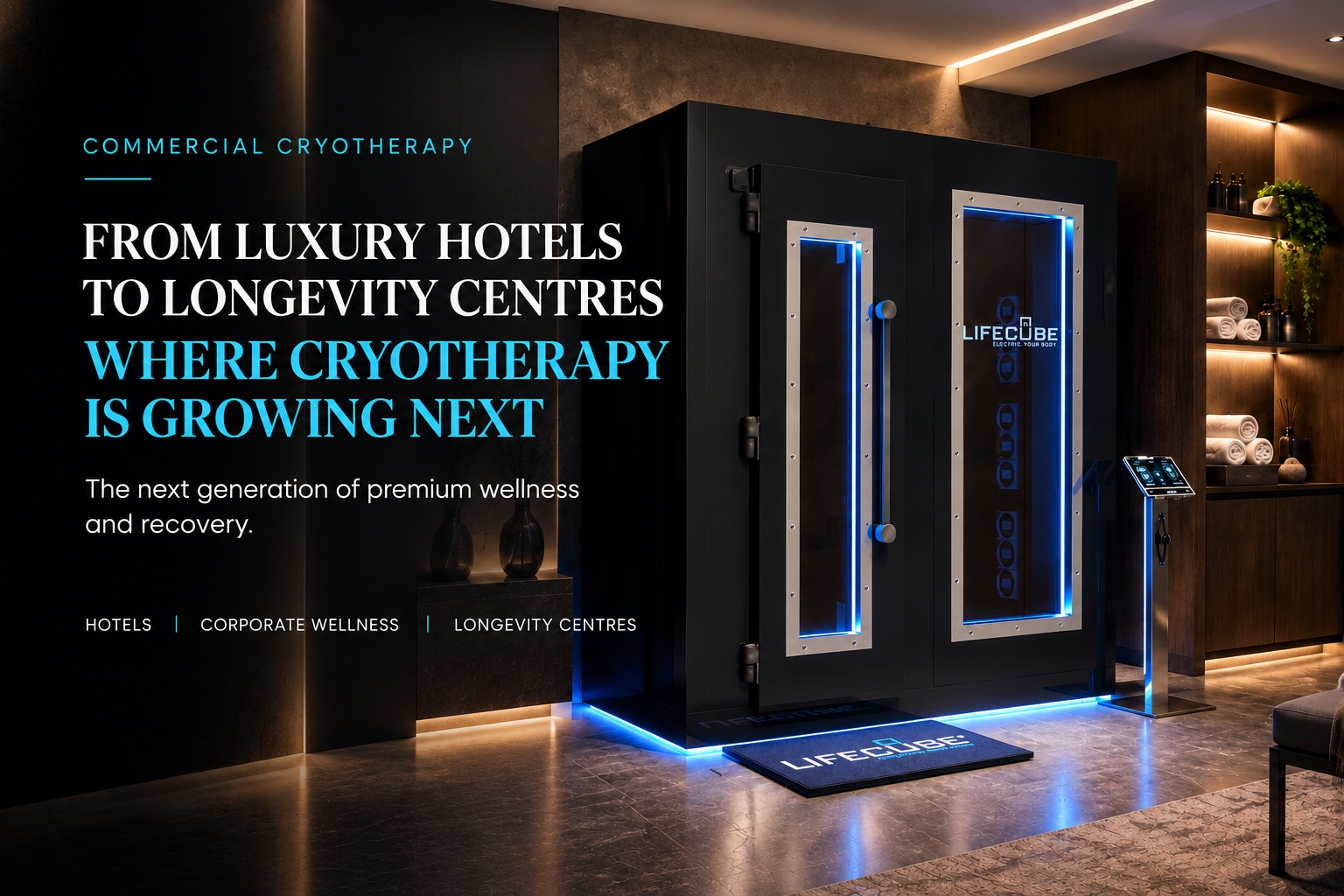

The recovery market is moving beyond traditional gyms and sports clinics.
Today, commercial cryotherapy is appearing in luxury hotels, premium wellness clubs, corporate wellbeing spaces and longevity centres. These businesses are looking for new ways to offer high-value recovery experiences while also standing out in competitive markets.
That shift reflects a much wider trend. The global wellness economy reached $6.8 trillion in 2024, according to the Global Wellness Institute, and it is projected to continue growing strongly through 2029.
As a result, cryotherapy is no longer viewed only as a tool for elite athletes. It is becoming part of a broader commercial wellness ecosystem.
In this guide, we explore where commercial cryotherapy is growing, why businesses are interested, and what operators should consider before adding it to their facility.
Commercial Cryotherapy Is Moving Beyond the Gym
Cryotherapy first became widely associated with professional sport, performance centres and specialist recovery studios.
However, the audience has expanded.
Consumers now spend more on recovery, wellness, longevity and preventative lifestyle services. Meanwhile, businesses are looking for experiences that feel premium, memorable and easy to integrate into a wider wellness offering.
That creates new opportunities for cryotherapy for wellness businesses.
Instead of being a stand-alone sports treatment, cryotherapy can now sit alongside services such as:
- Massage
- Sauna
- Cold-water immersion
- Compression therapy
- Recovery lounges
- Skin and aesthetic treatments
- Wellness assessments
- Longevity-focused services
For operators, this changes the role of the equipment.
A whole body cryotherapy machine is no longer simply a piece of sports equipment. In the right setting, it can become part of a wider customer journey.
Why Luxury Hotels Are Exploring Commercial Cryotherapy
Luxury hospitality is increasingly about more than a comfortable room and a good restaurant.
Guests now expect experiences.
Wellness tourism has become an important part of the wider travel market. Global Wellness Institute research has consistently identified wellness tourism as one of the faster-growing areas of the wellness economy.
As a result, hotels and resorts are investing in more sophisticated wellness facilities.
Recovery can become part of the guest experience
A hotel spa may already offer massage, sauna and fitness facilities.
Adding commercial cryotherapy creates another type of experience.
For example, a guest might:
- Complete a morning workout.
- Book a short recovery session.
- Use the spa or sauna later in the day.
- Return for another wellness service during their stay.
That gives the hotel more opportunities to build packages around recovery rather than offering treatments individually.
Cryotherapy can support premium positioning
Luxury hotels compete heavily on experience.
Therefore, unusual or advanced wellness recovery technology can help a property stand out.
The value is not simply that the chamber becomes another treatment.
Instead, it can contribute to how the entire wellness area is perceived.
A well-designed cryotherapy suite can feel modern, premium and different from a standard hotel spa.
Commercial Cryotherapy and the Rise of Longevity Centres
Longevity centres are another important market.
These businesses often combine several wellness, diagnostic and recovery services under one roof.
Their customers may be interested in:
- Healthy ageing
- Recovery
- Sleep
- Fitness
- Body composition
- Stress management
- Performance
- Preventative wellness
Therefore, commercial cryotherapy can fit naturally within the wider service mix.
Why cryotherapy fits the longevity model
Longevity centres rarely rely on one single treatment.
Instead, they create a broader programme.
For example, one facility might combine exercise testing, nutrition support, sauna, cold exposure, recovery technology and aesthetic services.
In that environment, cryotherapy becomes part of a wider wellness journey.
Importantly, businesses should avoid presenting cryotherapy as a treatment that can extend lifespan or prevent disease unless there is strong evidence for a specific claim.
The commercial opportunity is much simpler.
Cryotherapy can offer a short, premium recovery experience that fits alongside other wellness services.
The environment matters
Longevity customers often expect more than functional equipment.
They expect a polished experience.
Therefore, chamber design, room layout, noise, lighting and staff interaction all matter.
This is where a modern electric cryotherapy machine may be particularly relevant.
Electric systems can fit into permanent wellness environments without relying on liquid nitrogen as the cooling method.
Corporate Wellness Is Becoming More Sophisticated
Corporate wellness has also changed.
In the past, workplace wellness might have meant a discounted gym membership or an occasional health workshop.
Today, some employers are taking a broader approach.
The Global Wellness Institute estimated the workplace wellness market at $53.3 billion in 2024 and projects further growth through 2029.
However, that does not mean every office will install a cryotherapy chamber.
The opportunity is more likely to appear in:
- Large corporate wellness campuses
- Executive wellbeing facilities
- Premium workplace gyms
- Mixed-use business developments
- Corporate hospitality and wellness partnerships
- Employer-funded access to external recovery centres
Cryotherapy can work as part of a wider programme
For example, a company with a high-end fitness and wellbeing centre may want to offer employees more than exercise equipment.
A recovery zone could include:
- Mobility areas
- Massage
- Sauna
- Cold therapy
- Compression
- Commercial cryotherapy
However, the value should not be framed around unproven promises about productivity or sick leave.
Instead, the focus should remain on employee experience, access to wellness services and the creation of a more complete wellbeing environment.
Why Electric Systems Matter for Commercial Cryotherapy
As cryotherapy moves into hotels, longevity centres and corporate settings, the operational side becomes more important.
These environments have different needs from a specialist sports facility.
They often care about:
- Facility planning
- Guest experience
- Staffing
- Safety
- Service consistency
- Operating costs
- Space efficiency
- Maintenance
- Brand presentation
This is where electric systems become relevant.
No liquid nitrogen requirement
A fully electric cryotherapy machine generates cold through electrical refrigeration rather than liquid nitrogen.
Therefore, the operator does not need liquid nitrogen deliveries for chamber operation.
That can simplify part of the day-to-day workflow.
Easier integration into permanent wellness spaces
Hotels and longevity centres are often designed carefully.
They may have strict requirements around interior design, storage and customer flow.
Therefore, the equipment must fit the building as well as the treatment menu.
Electric cryotherapy can suit this type of permanent commercial installation.
However, businesses must still check:
- Electrical supply
- Room dimensions
- Ventilation requirements
- Heat output
- Installation access
- Service access
- Manufacturer specifications
Electric does not mean “no planning.”
It means the planning requirements are different.
Consistency matters
Hotels and premium wellness centres may serve customers throughout the day.
Therefore, operators need a system that can support a predictable schedule.
Before choosing a chamber, businesses should ask how quickly it reaches operating temperature, how many consecutive sessions it can support and what maintenance schedule is required.
Cryotherapy for Wellness Businesses: What Operators Should Consider
Adding a chamber is a commercial decision, not just a technology decision.
Businesses should look at the full operating model.
1. Who is the target customer?
Start with the customer.
A luxury hotel guest may have different expectations from a professional athlete or local recovery-club member.
Therefore, the treatment experience, price and marketing should reflect the audience.
2. How will the service generate revenue?
Operators should think beyond the price of one session.
Commercial cryotherapy can potentially be sold through:
- Individual sessions
- Treatment packages
- Wellness memberships
- Hotel spa packages
- Premium room or retreat packages
- Recovery memberships
- Cross-sells with other treatments
However, revenue projections should remain realistic.
Calculate expected demand using your own customer numbers rather than relying on ideal-case examples.
3. Does the space work?
Measure the room before choosing the system.
Also consider:
- Entrance width
- Floor access
- Ceiling height
- Electrical connections
- Client changing space
- Staff movement
- Waiting areas
This is particularly important in hotels and existing wellness centres where space may already be allocated.
4. How will staff operate it?
Staff training matters.
The team should understand:
- Client screening
- Session preparation
- Operating procedures
- Emergency procedures
- Cleaning
- Customer communication
Moreover, training should not end after installation.
Ask what ongoing support is available.
5. What is the total operating cost?
Do not look only at purchase price.
Instead, consider:
- Electricity
- Servicing
- Maintenance
- Staff time
- Finance or rental payments
- Insurance
- Room costs
- Marketing
This gives a more realistic picture of the investment.
Commercial Cryotherapy as Wellness Recovery Technology
The most important shift may be how businesses think about cryotherapy itself.
A few years ago, the conversation often focused on temperature.
Today, operators are thinking more broadly.
They want wellness recovery technology that fits their brand, building and service model.
That means the chamber needs to do more than simply become cold.
It should also support:
- A premium customer experience
- Smooth staff workflows
- Reliable session delivery
- Commercial utilisation
- Long-term support
As a result, the best system for one business may not be the best system for another.
A boutique wellness studio may prioritise footprint.
Meanwhile, a high-volume recovery centre may care more about session capacity.
A luxury hotel may place greater emphasis on design and client experience.
Where Could Commercial Cryotherapy Grow Next?
The next stage of the market is likely to be broader than sport.
Several sectors have a natural connection to recovery and wellness.
Luxury hospitality
Hotels can use cryotherapy to expand premium spa and recovery packages.
Longevity centres
These facilities can integrate cryotherapy alongside other recovery and lifestyle services.
Corporate wellness
Premium workplace facilities and external corporate wellness partnerships may create new opportunities.
Health clubs
High-end gyms can use cryotherapy as a membership upgrade or separate recovery service.
Wellness resorts
Destination wellness properties can include cryotherapy within structured retreat programmes.
Recovery studios
Specialist recovery businesses remain one of the clearest markets because cryotherapy naturally complements other recovery services.
Therefore, growth is likely to come from businesses that already understand the value of creating a wider wellness experience.
Commercial Cryotherapy Is Entering a Wider Wellness Market
Commercial cryotherapy is no longer limited to elite sport and specialist recovery centres.
Luxury hotels, longevity facilities, corporate wellness environments and premium health clubs are all exploring new ways to build recovery into the customer experience.
At the same time, the wider wellness economy continues to grow. Global wellness spending reached $6.8 trillion in 2024, which helps explain why businesses are investing more heavily in wellness experiences and infrastructure.
For operators, however, success depends on more than buying a chamber.
They need to choose the right technology, understand the customer, plan the space, train the team and build a realistic commercial model.
A whole body cryotherapy machine can become an important part of a modern wellness facility when it fits naturally into the wider service offering.
Meanwhile, an electric cryotherapy machine may help businesses integrate cryotherapy without depending on liquid nitrogen for chamber operation.
Considering commercial cryotherapy for your hotel, wellness centre, recovery studio or longevity business?
Explore LifeCube’s electric cryotherapy solutions and speak with the team about which system could fit your space, operating model and customer experience.
Frequently Asked Questions About Commercial Cryotherapy
What is commercial cryotherapy?
Commercial cryotherapy refers to professional cryotherapy systems used by businesses such as gyms, hotels, recovery centres, spas and wellness facilities. These systems are designed for repeated client use rather than home treatment.
Which businesses can offer commercial cryotherapy?
Potential operators include recovery studios, gyms, hotels, wellness centres, longevity clinics, spas and performance facilities. However, businesses should assess local regulations, space, training and operating requirements before installation.
Why are hotels adding cryotherapy?
Hotels may add cryotherapy to expand their wellness offering and create more premium guest experiences. It can sit alongside spa, fitness and recovery services.
Is commercial cryotherapy only for athletes?
No. Although cryotherapy is strongly associated with sport and recovery, commercial facilities increasingly market it to broader wellness audiences. However, businesses should always use responsible language and avoid unsupported medical claims.
What is the difference between electric and nitrogen cryotherapy?
An electric cryotherapy machine uses refrigeration technology to create the cold. Nitrogen systems rely on liquid nitrogen. Both technologies have different installation, operating and maintenance requirements.
How much space does a whole-body cryotherapy system need?
Space requirements vary between models. Therefore, businesses should check the exact chamber dimensions, clearance requirements and installation specifications before committing.
Can cryotherapy create a new revenue stream?
Potentially, yes. Businesses may sell sessions individually or include them in memberships and treatment packages. However, profitability depends on demand, pricing, utilisation and operating costs.
What should businesses look for when choosing a cryotherapy supplier?
Look at chamber technology, temperature range, capacity, installation support, staff training, warranty, maintenance, technical support and operating costs. The supplier relationship can be just as important as the machine itself.