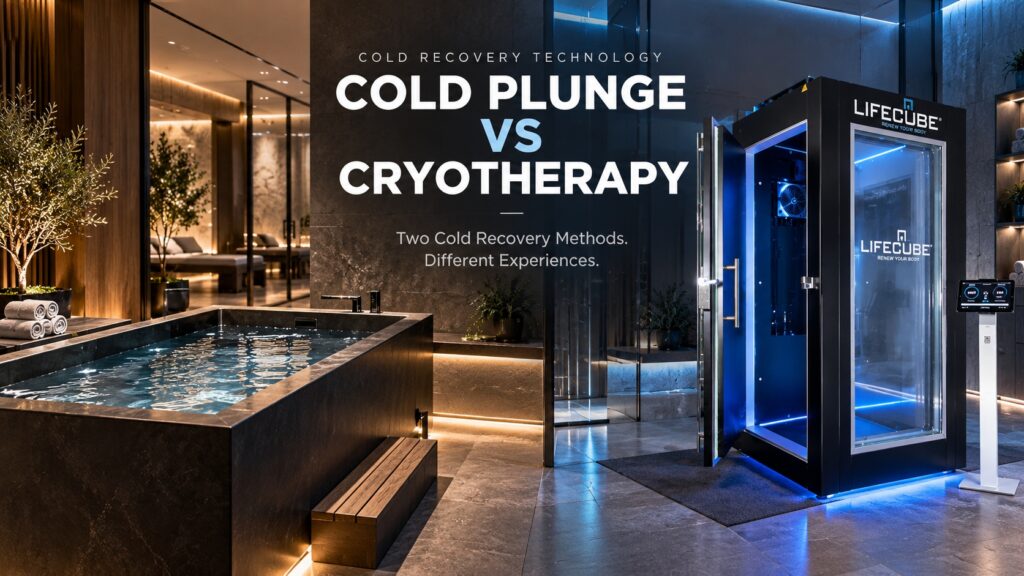
Cold plunge vs cryotherapy comparison showing a cold-water immersion tub and LifeCube electric whole-body cryotherapy chamber in a luxury wellness facility.

Cold plunges have become a familiar sight in gyms, spas and recovery studios. Meanwhile, whole-body cryotherapy is gaining attention as another way to experience controlled cold exposure.

But when comparing cold plunge vs cryotherapy, which option makes more sense?

Both expose the body to cold temperatures. However, they use different methods, require different equipment and create different experiences.

A cold plunge involves sitting or immersing yourself in chilled water. In contrast, whole body cryotherapy uses extremely cold air inside a specialist chamber for a short session.

Both approaches attract people interested in muscle recovery, sports performance and wellness. Yet neither guarantees faster recovery or better health.

For UK wellness businesses, the choice also involves installation, maintenance, staffing and customer experience.

This guide compares temperatures, session times, potential benefits, safety and commercial considerations to help you understand the differences.

Cold Plunge vs Cryotherapy: Understanding the Basics

Before comparing results, it helps to understand how each method works.

What is a cold plunge?

A cold plunge is a bath, tub or pool containing cold water.

Users immerse part or most of their body for a controlled period. The water commonly ranges from around 10°C to 15°C in sports recovery settings, although some facilities use colder temperatures.

Cold plunges are popular because the concept is simple. You enter cold water, remain there for a set period and leave when the session ends.

However, water removes heat from the body much faster than air at the same temperature.

As a result, cold-water immersion can feel intense even when the temperature is much higher than that of a cryotherapy chamber.

What is whole-body cryotherapy?

Whole body cryotherapy exposes the body to very cold, dry air inside a purpose-built chamber.

Commercial sessions typically last around two to three minutes, depending on the system and operating protocol.

Some electric chambers operate at temperatures around -80°C to -110°C. However, temperature ranges differ between manufacturers and models.

Unlike cold plunges, cryotherapy does not require users to immerse themselves in water.

Instead, they remain in a controlled cold-air environment while wearing appropriate protective clothing.

For many wellness operators, this creates a different type of premium recovery experience.

Cold Plunge vs Cryotherapy: Key Differences at a Glance

Both methods use cold exposure, but the experience and operating requirements differ.

Feature

Cold Plunge

Whole-Body Cryotherapy

Cooling method

Cold water

Very cold, dry air

Typical temperature

Around 10°C–15°C for many recovery protocols

Often around -80°C to -110°C, depending on equipment

Session duration

Often 5–15 minutes in studied protocols

Commonly 2–3 minutes

User experience

Partial or full immersion in water

Standing inside a specialist chamber

Clothing

Swimwear

Dry clothing and protective equipment

Hygiene

Water filtration, cleaning and water-quality management

Chamber cleaning and equipment maintenance

Installation

Plumbing or water handling, drainage and electrical requirements as applicable

Electrical supply, room conditions and manufacturer-specific installation

Commercial positioning

Accessible cold-water wellness experience

Technology-led premium recovery service

These figures describe common approaches, not universal operating instructions.

Importantly, colder air does not automatically mean stronger recovery effects. Water and air transfer heat differently, so chamber temperature alone cannot establish which treatment works better.

Which Offers Better Cold Therapy for Muscle Recovery?

One of the biggest reasons people explore cold exposure is exercise recovery.

After demanding physical activity, muscles may feel sore, heavy or fatigued. Therefore, athletes and active adults often look for ways to manage discomfort between sessions.

However, the research does not show that one cold treatment is best for everyone.

Cold plunge recovery: what does research suggest?

Cold water immersion has a substantial research history in sports recovery.

Some studies suggest it can reduce perceived muscle soreness after strenuous exercise.

For example, systematic reviews have found evidence of reduced delayed-onset muscle soreness after cold-water immersion compared with passive recovery.

However, results depend on water temperature, exposure time and the type of exercise.

Furthermore, frequent cold-water immersion immediately after resistance training may reduce some long-term muscle growth adaptations. This matters for people whose main goal is building muscle.

Therefore, timing and training goals should influence how someone uses cold exposure.

Cryotherapy benefits for post-exercise recovery

Researchers have also examined cryotherapy benefits following exercise.

Some studies report improvements in perceived soreness, fatigue and selected recovery measures.

However, evidence for whole-body cryotherapy remains mixed. Studies often use different temperatures, session schedules and participant groups.

As a result, it is difficult to establish one ideal protocol.

Cryotherapy should therefore complement established recovery practices rather than replace them.

Good sleep, adequate nutrition, hydration and sensible training loads remain essential.

Is cryotherapy better than a cold plunge?

Not necessarily.

Cold-water immersion has a larger evidence base for several exercise recovery outcomes. Meanwhile, whole-body cryotherapy offers a different experience that some people may prefer.

For example, someone who dislikes entering cold water may prefer a brief dry-air session.

In contrast, another person may enjoy the immersive experience of a cold plunge.

Ultimately, personal preference, safety, accessibility and recovery goals all matter.

Comparing Cold Plunge Benefits and Cryotherapy Benefits

Cold exposure can trigger several short-term responses in the body.

However, a physiological response does not always translate into a proven long-term health benefit.

Muscle soreness and fatigue

Both methods may help some users manage post-exercise soreness.

Cold-water immersion has more established evidence for reducing delayed-onset muscle soreness.

Meanwhile, cryotherapy research suggests potential improvements in perceived recovery, although findings remain less consistent.

Inflammation and recovery

Cold exposure can influence blood flow and some inflammatory responses.

However, inflammation also plays an important role in normal tissue repair and exercise adaptation.

Therefore, reducing inflammatory markers does not automatically mean someone will recover faster or perform better.

Mood and wellbeing

Some people describe feeling refreshed or alert after cold exposure.

Nevertheless, individual experiences vary.

Neither method should be promoted as a proven treatment for anxiety, depression or other medical conditions.

Weight loss and metabolism

Cold exposure requires the body to maintain its temperature.

However, neither cold plunges nor whole-body cryotherapy provide a reliable shortcut to weight loss.

Long-term nutrition, physical activity and lifestyle habits remain more important.

The most credible way to discuss cold plunge benefits and cryotherapy is to separate promising research from claims that science has not established.

Cold Plunge vs Cryotherapy: Which Is Better for Wellness Businesses?

For gym owners, spa directors and recovery-centre operators, the comparison goes beyond personal preference.

Both services can attract customers interested in recovery and wellness. However, each creates different operational responsibilities.

Installation and maintenance

A commercial cold plunge needs reliable water-quality management. Depending on the setup, this may include filtration, disinfection, drainage and temperature control.

Additionally, staff must monitor cleaning schedules and customer hygiene.

A commercial cryotherapy chamber requires a suitable electrical supply, adequate space and manufacturer-approved installation conditions.

Electric systems avoid liquid nitrogen deliveries. However, they still need maintenance, technical support and trained operators.

Session capacity and customer experience

Cryotherapy sessions are generally shorter than typical cold-water immersion protocols.

This can help businesses design structured appointment schedules.

However, actual throughput depends on preparation, screening, chamber recovery time and staff availability.

Cold plunges may suit facilities that already offer sauna circuits or contrast bathing.

In contrast, cryotherapy can complement premium recovery studios, physiotherapy clinics, luxury spas and performance centres.

Commercial costs

There is no universal cost winner.

A cold plunge may require a smaller initial investment, depending on its size and specification. However, commercial water treatment, energy consumption and maintenance create ongoing expenses.

Cryotherapy chambers generally represent a larger equipment investment. In return, businesses may be able to position sessions as a premium service.

For UK operators, compare total costs rather than purchase prices alone.

A practical business assessment should include:

  1. Equipment purchase or rental costs
  2. Installation and room preparation
  3. Energy and water consumption
  4. Cleaning and maintenance
  5. Staff training
  6. Realistic sessions per day
  7. Customer pricing and demand

For example, a business charging £35 per cryotherapy session and completing eight paid sessions daily would generate £280 in daily gross session revenue.

However, this is only an illustration. It excludes operating expenses, tax, downtime and other business costs.

Choosing the best cryotherapy machine

If your facility is considering cryotherapy, selecting the best cryotherapy machine means finding a system that matches your business needs.

Consider chamber capacity, electrical requirements, temperature control, customer comfort and technical support.

LifeCube offers German-engineered, fully electric, nitrogen-free cryotherapy chambers designed for professional recovery and wellness environments.

Its Plug & Play positioning can simplify some operational requirements. However, every installation still needs a proper site assessment.

Likewise, when evaluating a cryotherapy chamber for sale uk, ask about training, servicing, warranty and long-term running costs before making a decision.

Is Cold Plunge or Cryotherapy Safer?

Both methods involve exposure to cold temperatures. Therefore, neither is completely risk-free.

Cold-water immersion can trigger an immediate cold-shock response. This may cause rapid breathing, changes in heart rate and cardiovascular strain.

Meanwhile, whole-body cryotherapy can create risks such as cold injury, dizziness or problems linked to unsuitable operating procedures.

Some people should avoid cold exposure or seek medical advice first, particularly those with certain cardiovascular or circulatory conditions.

For commercial facilities, safety should include appropriate health screening, supervision, emergency procedures and staff training.

Importantly, users should never exceed the manufacturer’s recommended temperature or session duration.

Conclusion: Cold Plunge vs Cryotherapy — Which Should You Choose?

The cold plunge vs cryotherapy decision depends on your goals, preferences and operating requirements.

Cold-water immersion offers an accessible recovery experience with a substantial research base for post-exercise soreness.

Meanwhile, whole-body cryotherapy provides a brief, dry-air experience that may appeal to customers seeking a technology-led wellness service.

Neither method guarantees improved athletic performance or better health.

For businesses, the decision also involves customer demand, operational costs, safety and the experience you want to offer.

If you operate a UK gym, spa, physiotherapy clinic or recovery centre, electric cryotherapy may be worth exploring as part of a wider wellness offering.

Ready to explore whole-body cryotherapy for your facility?

LifeCube provides German-engineered, fully electric, nitrogen-free cryotherapy chambers, supported by commercial installation and training services.

Explore the LifeCube cryotherapy chamber range or contact the LifeCube team to discuss the right solution for your business.

Frequently Asked Questions

What is the main difference between cold plunge and cryotherapy?

A cold plunge uses cold water, while whole-body cryotherapy uses extremely cold air inside a chamber.

Cryotherapy sessions are usually shorter. However, the two methods transfer heat differently and cannot be compared using temperature alone.

Not consistently.

A 2026 review of 13 randomised trials involving 214 participants found that cold-water immersion performed better for short-term muscle soreness, particularly within 24 hours. Body cryotherapy showed a possible small benefit for jump-performance recovery, although that finding was uncertain.

Cryotherapy chambers operate at much lower air temperatures than cold plunges.

However, water transfers heat more efficiently than air. Therefore, a cold plunge can feel extremely intense despite having a higher numerical temperature.

Whole-body cryotherapy commonly lasts around two to three minutes.

Cold-water immersion research often uses longer exposures, but there is no universal safe duration. Always follow an appropriate protocol and obtain professional guidance where needed.

Some studies report changes in inflammatory markers after cryotherapy.

However, these findings do not establish that cryotherapy treats inflammatory diseases or delivers the same results for everyone.

A basic cold plunge usually costs less to purchase than a commercial cryotherapy chamber.

However, businesses should also consider water treatment, energy use, maintenance, staffing and expected revenue.

Yes. Cold plunges and cryotherapy can complement each other.

For example, a spa might include cold plunges within a thermal wellness circuit while offering cryotherapy as a separate appointment-based service.

Cryotherapy for dancers and performing artists during recovery
Dance · Performance · Recovery

Dancers ask a lot from their bodies. Long rehearsals, repeated jumps, fast changes of direction and demanding performances can place significant stress on muscles and joints. That is why recovery has become such an important part of modern dance training.

Cryotherapy for dancers is one recovery approach that has attracted growing interest among athletes, performers and sports recovery professionals. Whole-body cold exposure may help reduce the feeling of muscle soreness and support short-term recovery after demanding physical activity.

However, cryotherapy is not a replacement for sleep, nutrition, hydration, physiotherapy or a properly planned training programme. Instead, it can form part of a wider recovery strategy.

In this guide, we explore how cryotherapy for dancers works, when it may be useful, what dancers should consider before a session and how professional performance facilities can incorporate modern cold therapy into their recovery offering.

What Is Cryotherapy for Dancers?

Cryotherapy for dancers involves exposing the body to very cold temperatures for a short, controlled period.

Whole-body cryotherapy uses a specialised chamber to expose the body to extremely cold air. Unlike an ice bath, there is no need to immerse the body in water.

For dancers, the appeal is straightforward. A demanding rehearsal or performance can leave the legs feeling heavy, muscles feeling sore and the body generally fatigued. A structured recovery routine may help dancers feel more prepared for their next session.

Research into cold-based recovery methods has found potential benefits for muscle soreness and some measures of short-term physical recovery. However, results vary depending on the type of cold therapy, exercise performed and timing.

Therefore, dancers should view cryotherapy as one tool within a broader recovery plan rather than a guaranteed performance enhancer.

Why Do Dancers Need a Strong Recovery Strategy?

Dance is both an artistic discipline and a physically demanding activity.

A dancer may perform hundreds of jumps, turns, landings and rapid movements during training and rehearsal. Furthermore, professional dancers often repeat similar movements across several days while preparing for a performance.

This creates several common recovery challenges:

  • Muscle soreness after intensive rehearsals
  • Fatigue between training sessions
  • Heavy or tired legs
  • Repeated impact from jumps and landings
  • Limited recovery time between performances
  • Physical stress during intensive production periods
  • The need to maintain movement quality and technique

For example, a professional dancer may rehearse during the day and perform in the evening. The following morning, they may need to return to training.

In this situation, recovery becomes more than simply taking a day off.

Sleep, hydration, appropriate nutrition, mobility work and sensible training loads remain essential. However, additional recovery methods may help dancers manage the demands of a busy schedule.

How Can Cryotherapy for Dancers Support Recovery?

The main reason athletes and performers explore cold therapy is its potential effect on post-exercise soreness and perceived recovery.

Cold exposure can temporarily reduce skin and tissue temperature. It also changes blood flow and sensory responses during and after exposure.

For dancers, this may be particularly relevant following demanding sessions.

1. It May Help With Muscle Soreness

Delayed onset muscle soreness, commonly known as DOMS, can appear after unfamiliar or particularly demanding exercise.

Dance training can involve eccentric movements, landing forces and repeated muscular contractions. As a result, dancers may experience soreness in areas such as the:

  • Quadriceps
  • Hamstrings
  • Calves
  • Glutes
  • Hip muscles

Cold-based recovery methods have been studied for their potential to reduce perceived muscle soreness.

Therefore, cryotherapy for dancers may be considered after particularly demanding training sessions when soreness is affecting comfort and recovery.

2. It Can Fit Into a Busy Training Schedule

Time matters in professional dance.

A recovery method that takes a long time may be difficult to fit between rehearsals, classes and performances. Whole-body cryotherapy sessions are designed around short periods of cold exposure.

As a result, some performance facilities may integrate cryotherapy into a wider recovery programme alongside stretching, mobility work, massage or compression.

The key is not to treat one recovery method as a magic solution. Instead, dancers can build a routine around the strategies that suit their training demands.

3. It May Support Perceived Recovery

Recovery is not only about physical measurements.

How a dancer feels can also influence training quality. Feeling excessively sore or fatigued can make a demanding rehearsal feel harder.

Some research into post-exercise cold exposure suggests potential improvements in perceived recovery and muscle soreness. However, the response differs between individuals.

For this reason, dancers should monitor how they respond rather than assuming that cryotherapy will produce the same effect for everyone.

When Should Dancers Consider Cryotherapy?

There is no single timing strategy that works for every dancer.

Instead, the most useful approach depends on the training schedule, workload and individual response.

After a High-Intensity Rehearsal

A demanding rehearsal may place considerable stress on the lower body.

If a dancer regularly experiences significant soreness after particularly intense sessions, cold therapy could form part of their post-training recovery routine.

During a Performance Run

Performing several shows across a short period can reduce the amount of time available for recovery.

For example, a dancer performing consecutive evening shows may have limited time between performances. In such circumstances, recovery strategies become especially important.

After Unusually Demanding Training

A new choreography routine, additional jumps or an increase in training volume can place different demands on the body.

However, dancers should not use cryotherapy to mask pain and continue training through a suspected injury.

Persistent or severe pain should be assessed by an appropriate healthcare professional.

Cryotherapy vs Other Recovery Methods for Dancers

Cryotherapy does not have to compete with other recovery strategies.

In fact, dancers may benefit from combining different approaches according to their needs.

Recovery method Potential role
SleepSupports overall physical and mental recovery
HydrationHelps maintain normal physiological function
NutritionProvides energy and nutrients needed for training
Mobility workSupports movement and preparation
MassageMay help with relaxation and perceived muscle soreness
CompressionOften used as part of post-exercise recovery routines
Cold therapyMay help manage post-exercise soreness and perceived recovery
PhysiotherapyImportant for assessment and rehabilitation when injuries occur

The most effective recovery programme is therefore usually a combination rather than a single treatment.

Moreover, dancers should consider their individual training load, performance calendar and previous injury history when deciding which recovery methods to use.

Is Cryotherapy Safe for Dancers?

Whole-body cryotherapy involves exposure to extremely low temperatures, so it should always be approached as a controlled procedure.

Dancers should follow the facility's instructions and disclose relevant health information during the pre-session screening process.

Importantly, cryotherapy should not be used as a way to ignore an injury.

If a dancer has significant pain, swelling, reduced movement or an injury that has not been assessed, they should seek appropriate professional advice rather than relying on cold exposure alone.

It is also important to remember that research on cryotherapy does not support every marketing claim sometimes associated with the treatment. The strongest evidence relates to specific aspects of recovery, such as perceived muscle soreness, while effects on performance can vary.

Therefore, a responsible recovery programme should focus on realistic outcomes.

How to Build a Recovery Routine Around Cryotherapy

For dancers who are interested in trying cold therapy, a simple recovery framework can help.

Step 1: Identify the Training Demand

Consider how hard the rehearsal, class or performance was.

Was it a normal session, or was the workload significantly higher than usual?

Step 2: Prioritise the Basics

Before adding recovery technology, make sure the basics are covered:

  • Get enough sleep
  • Stay hydrated
  • Eat enough to support training
  • Include appropriate rest periods
  • Follow a sensible training plan

Step 3: Add Recovery Tools Where Appropriate

If soreness or fatigue remains an issue, consider whether methods such as mobility work, massage, compression or cold therapy could fit into the routine.

Step 4: Monitor Your Response

Keep track of how you feel before and after sessions.

For example, dancers can monitor soreness, perceived fatigue, sleep and training quality.

Over time, this can help identify which recovery strategies actually work for them.

Final Thoughts: Could Cryotherapy Be Part of Better Dance Recovery?

Dancers place exceptional demands on their bodies. Therefore, recovery deserves the same level of attention as training.

Cryotherapy for dancers may offer a useful way to support recovery from demanding rehearsals and performances, particularly when muscle soreness and fatigue are part of a busy training schedule.

However, the fundamentals still matter most. Good sleep, nutrition, hydration, appropriate training loads and professional injury management should remain the foundation.

For dance companies, sports facilities, performance centres and wellness businesses, modern whole-body cryotherapy can also create an opportunity to build a more complete recovery experience.

If your business is exploring cold therapy for dancers, athletes or performing artists, learn more about the benefits of an electric cryotherapy machine or explore options for a cryotherapy chamber for sale UK.

Speak with the LifeCube team to discuss your requirements and discover how electric whole-body cryotherapy could fit into your recovery or wellness facility.

Frequently Asked Questions About Cryotherapy for Dancers

Is cryotherapy good for dancers?

Cryotherapy may help dancers manage post-exercise muscle soreness and support perceived recovery. However, results vary between individuals, and it should form part of a broader recovery strategy rather than replace sleep, nutrition, physiotherapy or appropriate rest.

How does cryotherapy help after dance training?

Cold exposure can temporarily reduce tissue temperature and alter sensory and blood-flow responses. Research on cold-based recovery suggests that it may reduce perceived muscle soreness following strenuous exercise.

Can dancers use cryotherapy after a performance?

Yes, dancers may consider cryotherapy as part of their post-performance recovery routine. However, the timing and suitability should depend on the individual's training demands, health and response to cold exposure.

How long does a whole-body cryotherapy session take?

Whole-body cryotherapy sessions are typically short. The exact duration and temperature depend on the equipment, operating protocol and individual facility.

Always follow the manufacturer's instructions and the facility's professional guidance.

Is an electric cryotherapy machine suitable for sports recovery facilities?

An electric cryotherapy machine can be suitable for commercial recovery environments, depending on the facility's space, operating requirements and business model. Electric systems use refrigeration rather than liquid nitrogen, which can simplify the operational model for some businesses.

Can cryotherapy replace physiotherapy?

No. Cryotherapy should not replace assessment or rehabilitation from a qualified healthcare professional. A dancer with persistent pain or an injury should seek appropriate clinical advice.

Can cryotherapy improve dance performance?

The evidence is mixed. Some studies suggest potential benefits for aspects of recovery, while performance effects can vary depending on the exercise and timing. Therefore, cryotherapy should be viewed primarily as a recovery tool rather than a guaranteed performance enhancer.

Where can a business buy a cryotherapy chamber in the UK?

Businesses researching a cryotherapy chamber for sale UK should compare technology, installation requirements, safety documentation, operating costs, maintenance, staff training and after-sales support rather than focusing only on the purchase price.

LifeCube · Commercial Cryotherapy

Explore Electric Cryotherapy for Your Facility

Discover how electric whole-body cryotherapy could fit into a dance studio, performance centre, sports recovery facility or wellness business.

Explore LifeCube →

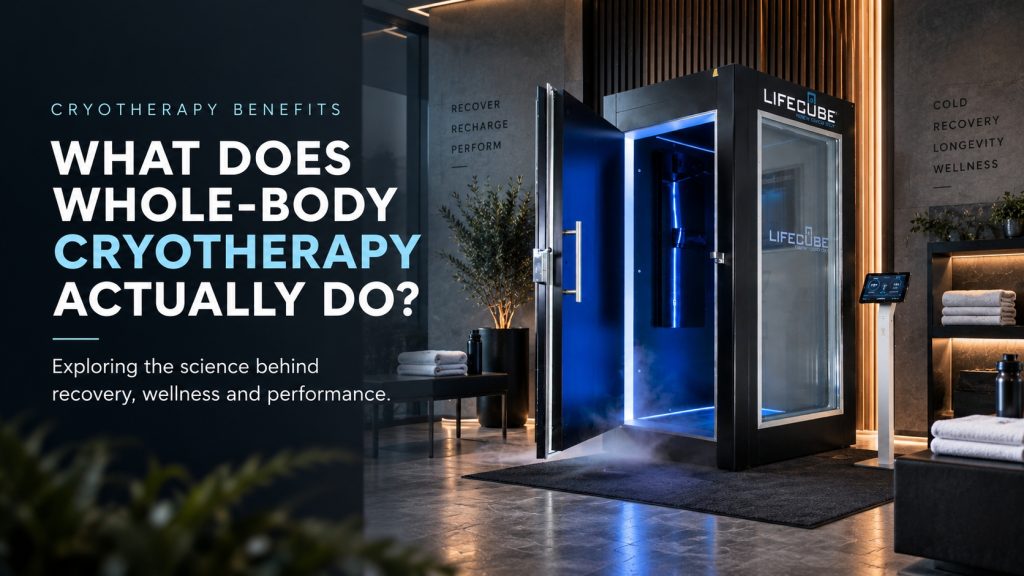
Modern golf club recovery and wellness facility with cryotherapy chamber
Home / Insights / Golf Club Recovery
Golf · Recovery · Commercial Wellness

Golf is often seen as a low-impact sport. However, that does not mean it places little demand on the body.

A full round can involve hours of walking, repeated rotational movement, practice swings, driving-range sessions and time spent carrying or pushing equipment. Research also shows that golfers commonly experience musculoskeletal issues involving the lower back, hand, wrist, shoulder and elbow.

That is one reason golf club recovery is becoming more relevant.

For modern clubs and premium resorts, the opportunity goes beyond helping golfers feel better after a round. Recovery can become part of the wider member experience, alongside fitness, coaching, spa services and hospitality.

This article looks at why golf club recovery is gaining attention, what golfers actually need, and how clubs can introduce recovery services in a way that feels useful rather than gimmicky.

Why Golf Club Recovery Is Becoming More Important

Golf may not involve tackles or repeated sprinting, but the physical demands are real.

The golf swing places rotational stress through the trunk, hips, shoulders, knees and lower back. Meanwhile, golfers may repeat that movement dozens of times during a round and many more times during practice. Reviews of golf injuries consistently identify the lumbar spine as one of the most common problem areas.

Therefore, recovery for golfers is not only relevant after injury.

It can also support a wider routine that includes mobility work, warm-ups, strength training, rest and recovery between rounds.

Golfers need consistency, not just performance

Most club golfers are not trying to become professional athletes.

Instead, they want to:

  • Play regularly
  • Move comfortably
  • Stay mobile
  • Recover between rounds
  • Maintain a consistent routine
  • Enjoy golf for many years

That changes the conversation.

Rather than focusing only on performance, clubs can position golf recovery around comfort, consistency and long-term participation.

A 2025 scoping review on recovery in professional and elite amateur golfers highlighted that golf places both physical and cognitive demands on players and that recovery is important during periods of frequent training, travel and competition.

The Modern Golf Club Is More Than a Course

Premium clubs increasingly compete on more than fairways and greens.

Members also judge:

  • Clubhouse quality
  • Food and hospitality
  • Coaching
  • Fitness facilities
  • Spa and wellness services
  • Changing rooms
  • Social areas
  • Member experience

As a result, golf club wellness is becoming a more relevant commercial conversation.

A recovery area can extend the experience beyond the final hole.

For example, a member could finish a round, have a post-round meal, complete a short mobility session and use a recovery service before leaving.

That creates a more complete visit.

Recovery can strengthen the premium member experience

The value of recovery does not need to come from making dramatic performance claims.

Instead, it can simply offer members another reason to spend time at the club.

For premium golf resorts, this is especially relevant.

Guests may already expect:

  • Spa treatments
  • Gym access
  • Sauna
  • Massage
  • Pool facilities
  • Personal training

Adding golf recovery technology can build on that existing wellness offering.

What Should Golf Recovery Facilities Include?

There is no single formula for recovery facilities for golf clubs.

The right setup depends on the type of club, available space, budget and member profile.

A smaller private club may start with mobility and recovery zones.

A luxury golf resort may build a full wellness suite.

Common recovery options include:

  • Mobility and stretching areas
  • Sports massage
  • Physiotherapy
  • Compression therapy
  • Sauna
  • Cold-water immersion
  • Cryotherapy
  • Recovery lounges

The important point is integration.

Recovery should feel like part of the club experience, not a random collection of equipment.

Start with member needs

Before investing, clubs should ask:

  1. Who will use the service?
  2. When are members most likely to use it?
  3. Is the goal recovery, wellness or both?
  4. Will the service be included in membership?
  5. Will it operate as a paid add-on?
  6. Is there enough staff support to run it well?

These questions matter more than simply buying the latest technology.

How Cryotherapy Fits Into Golf Club Recovery

Cryotherapy is one option within a broader golf recovery strategy.

Whole-body cryotherapy involves brief exposure to very cold air in a specialist chamber.

For golf clubs, the appeal is mostly about convenience and positioning.

Sessions are short, which means they can fit around a round, a practice session or a wider wellness appointment.

However, clubs should avoid presenting cryotherapy as a guaranteed way to improve swing speed, lower a handicap or prevent injury.

The evidence is more nuanced.

Cryotherapy research in sport suggests it may influence soreness, fatigue and certain recovery markers, but results vary by method, timing and outcome. Therefore, it is better positioned as one recovery tool among several rather than a replacement for sleep, nutrition, strength work or physiotherapy.

Where a whole-body cryotherapy machine fits

A whole body cryotherapy machine can work well in a club that already has:

  • A spa
  • A recovery suite
  • A wellness centre
  • A fitness facility
  • A sports performance programme

For premium clubs, the chamber can also support the visual identity of the recovery area.

A well-designed cryotherapy room can feel modern, high-end and relevant to members who already invest in golf, fitness and wellness.

Why Electric Cryotherapy Can Suit Golf Clubs

One practical question is how cryotherapy fits into club operations.

That is where an electric cryotherapy machine can become relevant.

LifeCube currently offers German-engineered electric cryotherapy chambers designed without nitrogen. Its commercial systems are positioned for wellness centres, recovery studios and performance facilities.

For golf clubs, this may simplify some operational planning.

No liquid nitrogen requirement

A fully electric system does not depend on liquid nitrogen to create the treatment environment.

That means no nitrogen deliveries or cylinder storage for chamber operation.

For a golf club or resort, that may be useful because the facility already manages:

  • Hospitality
  • Grounds
  • Fitness
  • Spa
  • Changing facilities
  • Food and beverage
  • Guest services

Reducing another consumable supply can make the cryotherapy operation easier to manage.

Commercial installation still needs planning

Electric does not mean “no infrastructure.”

For example, LifeCube lists specific power, room temperature, humidity and installation requirements for its systems.

Therefore, clubs should check:

  • Electrical supply
  • Room size
  • Cooling requirements
  • Access for installation
  • Service access
  • Staff training

Golf Club Recovery as a Commercial Opportunity

Recovery can add value to the member experience.

It may also create a new revenue stream.

However, clubs should avoid assuming that demand will automatically appear.

Instead, build the service around existing member behaviour.

Possible commercial models include:

  • Pay-per-session recovery
  • Premium membership upgrades
  • Golf + recovery packages
  • Weekend resort packages
  • Spa add-ons
  • Corporate golf-day wellness packages
  • Post-round recovery bundles

Example: premium golf resort package

A resort might offer:

Example package

18 holes + lunch + recovery session + spa access

That creates a broader experience than golf alone.

Similarly, a private members' club could introduce a premium wellness tier that combines fitness, massage and cryotherapy.

The key is relevance.

Recovery works best when it solves a clear member need and fits naturally into the club's existing offer.

How Golf Clubs Should Evaluate Recovery Technology

Before buying any golf recovery technology, clubs should evaluate the full commercial picture.

1. Member demand

Do members already use:

  • Massage?
  • Sauna?
  • Fitness?
  • Physio?
  • Recovery treatments?

If yes, that may indicate a stronger fit.

2. Location inside the club

Recovery works best when access is easy.

A chamber placed far away from the changing rooms or wellness area may get less use.

3. Staff involvement

Who will operate the service?

Clubs need trained staff who understand screening, session procedures and customer communication.

4. Expected utilisation

Estimate realistic use.

Do not build the business case on full capacity from day one.

Start with conservative session numbers.

5. Long-term support

Equipment support matters.

Ask about:

  • Warranty
  • Maintenance
  • Technical assistance
  • Replacement parts
  • Training
  • Installation

LifeCube states that its commercial packages include installation, commissioning, training and support.

Why Golf Club Wellness Is Likely to Keep Growing

The broader golf experience is changing.

Members increasingly combine sport with fitness, wellness, travel and hospitality.

That makes golf wellness a natural area for clubs to explore.

Recovery can sit at the centre of that shift because it connects several parts of the member journey:

  • Playing
  • Training
  • Mobility
  • Wellness
  • Spa
  • Hospitality

Instead of viewing recovery as a niche treatment, clubs can treat it as part of the total experience.

That does not mean every club needs a cryotherapy chamber.

However, premium clubs and resorts with an existing wellness audience may have a strong reason to consider one.

Golf Club Recovery Is Becoming Part of the Modern Member Experience

Golf club recovery is no longer only relevant to elite players.

It can also support recreational golfers who want to stay comfortable, mobile and consistent throughout the season.

For golf clubs, the opportunity is wider.

Recovery can strengthen the member experience, support premium wellness positioning and create new commercial services.

A whole body cryotherapy machine can become part of that offering when it fits naturally into a club's recovery or wellness space.

Meanwhile, an electric cryotherapy machine may offer a practical route for clubs that want a permanent cryotherapy service without relying on liquid nitrogen for chamber operation.

Frequently Asked Questions About Golf Club Recovery

What is golf club recovery?

Golf club recovery refers to services, facilities and technology designed to help golfers recover after rounds, practice or training.

This can include mobility work, massage, sauna, cold therapy, physiotherapy and cryotherapy.

Why is recovery important for golfers?

Golf involves repeated rotational movement and can place stress on the lower back, shoulders, wrists and other areas.

Therefore, recovery can support comfort, mobility and consistency between rounds.

What recovery services can a golf club offer?

Clubs can offer massage, mobility areas, compression, sauna, cold-water immersion, physiotherapy and whole-body cryotherapy.

The best mix depends on member demand and available space.

Is cryotherapy suitable for golf clubs?

It can be, especially for premium clubs and resorts with an established wellness or recovery offering.

However, clubs should assess space, staffing, infrastructure, expected demand and operating costs before investing.

What is the benefit of electric cryotherapy for golf clubs?

An electric cryotherapy machine does not require liquid nitrogen for chamber operation.

That can simplify supply management and make the system easier to integrate into a permanent wellness facility.

Can golf recovery create extra revenue?

Potentially.

Clubs can charge per session or include recovery in premium memberships, wellness packages or resort offers.

However, revenue depends on demand, pricing and utilisation.

LifeCube · Commercial Cryotherapy

Explore Electric Cryotherapy for Your Club

Discover how LifeCube's electric cryotherapy technology could fit into a golf club, resort or premium wellness facility.

Explore LifeCube →
Whole-body cryotherapy chamber highlighting cryotherapy benefits for recovery and wellness

Whole-body cryotherapy has moved from specialist sports environments into gyms, recovery centres and wellness facilities. However, many people still want a clear answer to one question: what are the real cryotherapy benefits?

In simple terms, whole-body cryotherapy exposes the body to very cold, dry air for a short period inside a purpose-built chamber. People commonly use it as part of a recovery or wellness routine, especially after demanding exercise.

Research suggests that whole-body cryotherapy may influence muscle soreness, fatigue and some markers linked with inflammation. However, the evidence is not equally strong for every claimed benefit, and results can vary between people and protocols.

This guide explains what whole-body cryotherapy does, where the evidence is strongest, what remains uncertain and how it can fit into a sensible recovery routine.

What Is Whole-Body Cryotherapy?

Whole-body cryotherapy, often shortened to WBC, involves entering a chamber that exposes most or all of the body to very low air temperatures for a brief period.

Unlike an ice bath, the treatment uses cold air rather than cold water.

Modern systems can use either nitrogen or electric refrigeration. LifeCube, for example, manufactures fully electric chambers designed for commercial wellness and recovery environments. Its current UK range includes nitrogen-free systems with temperatures down to -110°C, depending on the model.

How does whole-body cryotherapy work?

When you enter a very cold environment, your body reacts quickly.

Blood vessels near the skin narrow, and the body works to conserve heat. After the session, circulation gradually returns towards normal as you warm up.

Researchers have also studied changes in inflammatory markers, perceived soreness, fatigue and muscle function after cold exposure.

However, this does not mean every physiological response automatically translates into a meaningful health or performance improvement.

That distinction is important when discussing cryotherapy health benefits.

Cryotherapy Benefits for Muscle Recovery

One of the most researched areas is post-exercise recovery.

Athletes and active people often use cryotherapy after hard training, competitions or periods of increased exercise volume.

Can cryotherapy reduce muscle soreness?

It may help in some situations.

A 2024 systematic review and meta-analysis found that cryostimulation methods, including whole-body cryotherapy, could reduce perceived muscle pain and fatigue after exercise. However, the same analysis found no consistent improvement in exercise performance across all cryostimulation methods.

Earlier research has also reported reductions in muscle soreness following whole-body cryotherapy, although study protocols vary considerably.

Therefore, the most realistic cryotherapy recovery benefits relate to recovery support rather than guaranteed performance gains.

Where might it fit?

People may consider cryotherapy after:

  • High-intensity training
  • Heavy strength sessions
  • Competitive sport
  • Long endurance events
  • Repeated training days
  • Periods of increased training volume

However, cryotherapy should complement the basics.

Sleep, nutrition, hydration and sensible training remain essential.

Cryotherapy Benefits and Inflammation

Another area of research involves inflammation.

Exercise naturally creates temporary inflammatory responses. These responses form part of how the body adapts to training.

A 2025 meta-analysis of 11 randomised controlled trials involving 274 participants found that whole-body cryotherapy influenced several inflammatory markers. The researchers reported lower IL-1β and higher IL-10 levels after WBC, although effects differed between populations.

This suggests that one of the potential benefits of cryotherapy may involve changes in inflammatory signalling.

However, this does not mean cryotherapy should be described as a treatment for inflammatory disease in a general wellness setting.

Why the wording matters

It is more accurate to say:

Whole-body cryotherapy may influence inflammatory markers after exercise.

Rather than:

Cryotherapy cures inflammation.

The first reflects the available research. The second overstates it.

For an evidence-led wellness article, that difference matters.

Cryotherapy Recovery Benefits for Active People

Recovery is not only relevant to professional athletes.

Many recreational gym users, runners, cyclists and active adults also experience soreness and fatigue.

That is why cryotherapy recovery benefits attract such broad interest.

Cryotherapy and DOMS

Delayed-onset muscle soreness, or DOMS, usually develops after unfamiliar or demanding exercise.

Cold-based therapies are often used to manage this feeling.

However, cryotherapy is not always the most effective cold method.

A 2026 systematic review comparing body cryotherapy with cold-water immersion found that cold-water immersion was more effective for reducing DOMS within 24 hours. The difference became less clear at 48 hours.

A newer network meta-analysis also found that different cold therapies perform differently depending on the outcome and time point being measured. Whole-body cryotherapy performed well for some muscle-damage and jump-performance outcomes, while cold-water immersion performed better for some soreness and inflammatory measures.

Therefore, cryotherapy should not be marketed as universally superior to ice baths.

The better choice depends on:

  • Your recovery goal
  • Personal preference
  • Access
  • Time available
  • Training schedule
  • How your body responds

Cryotherapy Benefits for Performance: What Does the Evidence Say?

This is where marketing claims often move faster than science.

Whole-body cryotherapy may support recovery, but that does not mean it directly improves strength, endurance or speed.

A 2024 systematic review found that cryostimulation reduced muscle pain and perceived fatigue, yet did not consistently improve exercise performance.

Meanwhile, a 2026 network meta-analysis reported improvements in countermovement jump recovery after whole-body cryotherapy at several post-exercise time points.

So, what should you take from this?

The evidence suggests that performance effects depend heavily on:

  • Timing
  • Type of exercise
  • Cryotherapy protocol
  • Number of sessions
  • Recovery measure
  • Athlete characteristics

Therefore, the strongest case for cryotherapy is still recovery support rather than guaranteed performance enhancement.

Recovery can still matter for performance

If someone feels less sore or better recovered between hard sessions, they may find it easier to train consistently.

However, that is an indirect relationship.

Cryotherapy does not replace:

  • Structured programming
  • Sleep
  • Nutrition
  • Strength work
  • Mobility
  • Rest days

Instead, it may sit alongside them.

Other Possible Cryotherapy Health Benefits

Whole-body cryotherapy has also been studied beyond exercise recovery.

Researchers have explored areas including:

  • Pain
  • Sleep
  • mood
  • inflammation
  • neurological responses
  • chronic conditions

A large safety-focused scoping review noted research suggesting possible effects on sleep quality, neuromuscular recovery and pain in some populations. However, it also highlighted the need to consider safety and treatment protocols carefully.

Therefore, many wider cryotherapy health benefits remain areas of ongoing research.

What about mood and wellbeing?

Some people report feeling refreshed or energised after a session.

However, subjective feelings should not be treated as proof that cryotherapy treats anxiety, depression or other mental health conditions.

If cryotherapy forms part of a general wellness routine, that is different from presenting it as a medical treatment.

What about weight loss?

This is another area where claims often become exaggerated.

Cold exposure increases the body's effort to maintain temperature. However, that does not mean a short cryotherapy session should be marketed as a reliable weight-loss method.

Sustainable weight management still depends mainly on long-term nutrition, physical activity, sleep and lifestyle habits.

Is Whole-Body Cryotherapy Safe?

Safety matters whenever people are exposed to extreme temperatures.

A scoping review of whole-body cryotherapy safety found that adverse events have been reported, although risk depends on equipment type, protocol and supervision. The authors also noted that some reported incidents involved nitrogen-based partial-body systems rather than enclosed electric whole-body chambers.

Therefore, reputable providers should use:

  • Clear screening procedures
  • Appropriate staff training
  • Manufacturer protocols
  • Correct session durations
  • Suitable clothing and protective equipment
  • Properly maintained equipment

Anyone with a medical condition should speak with an appropriate healthcare professional before trying whole-body cryotherapy.

How Does an Electric Whole-Body Cryotherapy Chamber Work?

Electric systems use refrigeration technology rather than liquid nitrogen.

A commercial whole body cryotherapy machine can create a controlled cold environment while avoiding nitrogen deliveries and cylinder storage.

LifeCube's UK systems are fully electric and designed for professional wellness, recovery and performance environments. Its chamber range includes single- and double-chamber systems with operating temperatures that vary by model.

Why businesses choose electric systems

For commercial operators, the attraction is often practical.

An electric chamber can remove the need for:

  • Liquid nitrogen deliveries
  • Nitrogen cylinder storage
  • Per-session nitrogen consumption
  • Gas-handling logistics

LifeCube also states that its commercial packages include installation, commissioning, training and ongoing support.

If you are comparing equipment, a cryotherapy machine for sale should be assessed on much more than temperature alone.

Businesses should also consider:

  • Electrical requirements
  • Chamber capacity
  • Session throughput
  • Installation
  • Staff training
  • Warranty
  • Maintenance
  • Technical support
  • Total operating cost

Who Might Consider Whole-Body Cryotherapy?

Cryotherapy may appeal to several types of users.

These include:

  • Athletes
  • Gym members
  • Runners
  • Cyclists
  • Golfers
  • Combat-sport athletes
  • Active adults
  • Wellness customers

However, the goal should be clear.

For example, someone using cryotherapy after a demanding training block has a different objective from a hotel guest trying a wellness treatment for the first time.

The session should always match the user's needs and the provider's operating protocols.

What Do Cryotherapy Benefits Really Mean?

The strongest evidence around cryotherapy benefits currently centres on recovery.

Whole-body cryotherapy may help with muscle soreness, perceived fatigue and certain biological recovery markers. Some research also suggests effects on inflammation and short-term muscle function. However, results depend on the protocol, user and outcome being measured.

That makes balance important.

Cryotherapy is not a replacement for sleep, nutrition, physiotherapy or good training decisions.

Instead, it can become one part of a broader recovery and wellness routine.

For businesses considering professional cryotherapy, the equipment matters too. A whole body cryotherapy machine should offer reliable temperature control, suitable capacity, professional installation and strong ongoing support.

Likewise, anyone evaluating a cryotherapy machine for sale should consider the total operating model rather than focusing only on headline temperature or purchase price.

LifeCube provides fully electric, German-engineered whole-body cryotherapy chambers for professional recovery, wellness and performance facilities in the UK.

Explore LifeCube's electric cryotherapy systems or speak with the team to find out which chamber could fit your facility.

Frequently Asked Questions

What are the main cryotherapy benefits?

The most studied cryotherapy benefits relate to post-exercise recovery.

Research suggests whole-body cryotherapy may influence muscle soreness, perceived fatigue and some inflammatory markers. However, results vary between studies and individuals.

Does cryotherapy help muscle recovery?

It may help support certain aspects of recovery.

Studies have reported changes in soreness, fatigue and muscle-damage markers after cryotherapy. However, cryotherapy should complement sleep, nutrition and sensible training rather than replace them.

Does cryotherapy improve athletic performance?

Not consistently.

Some studies report short-term improvements in specific performance measures, while broader reviews show mixed results. Therefore, cryotherapy is better viewed as a recovery tool than a guaranteed performance enhancer.

Is cryotherapy better than an ice bath?

Not always.

Cold-water immersion appears more effective for some short-term soreness outcomes, while whole-body cryotherapy may perform better for certain other recovery markers.

How long does a cryotherapy session last?

Whole-body cryotherapy sessions are usually brief and commonly last only a few minutes, although exact duration depends on the equipment and protocol.

Always follow the facility's operating guidance.

How often should you use cryotherapy?

There is no universal schedule that works for everyone.

Research uses different frequencies and protocols, so the ideal number of sessions depends on your goals, activity level and response.

Can cryotherapy help with inflammation?

Research shows that whole-body cryotherapy can influence certain inflammatory markers. However, this should not be interpreted as proof that cryotherapy treats inflammatory diseases.

Is whole-body cryotherapy safe?

It can be delivered safely when appropriate screening, equipment and operating procedures are used.

However, adverse events have been reported, so proper supervision and manufacturer guidance matter.

commercial cryotherapy is expanding beyond gyms into luxury hotels, corporate wellness and longevity centres

The recovery market is moving beyond traditional gyms and sports clinics.

Today, commercial cryotherapy is appearing in luxury hotels, premium wellness clubs, corporate wellbeing spaces and longevity centres. These businesses are looking for new ways to offer high-value recovery experiences while also standing out in competitive markets.

That shift reflects a much wider trend. The global wellness economy reached $6.8 trillion in 2024, according to the Global Wellness Institute, and it is projected to continue growing strongly through 2029.

As a result, cryotherapy is no longer viewed only as a tool for elite athletes. It is becoming part of a broader commercial wellness ecosystem.

In this guide, we explore where commercial cryotherapy is growing, why businesses are interested, and what operators should consider before adding it to their facility.

Commercial Cryotherapy Is Moving Beyond the Gym

Cryotherapy first became widely associated with professional sport, performance centres and specialist recovery studios.

However, the audience has expanded.

Consumers now spend more on recovery, wellness, longevity and preventative lifestyle services. Meanwhile, businesses are looking for experiences that feel premium, memorable and easy to integrate into a wider wellness offering.

That creates new opportunities for cryotherapy for wellness businesses.

Instead of being a stand-alone sports treatment, cryotherapy can now sit alongside services such as:

  • Massage
  • Sauna
  • Cold-water immersion
  • Compression therapy
  • Recovery lounges
  • Skin and aesthetic treatments
  • Wellness assessments
  • Longevity-focused services

For operators, this changes the role of the equipment.

A whole body cryotherapy machine is no longer simply a piece of sports equipment. In the right setting, it can become part of a wider customer journey.

Why Luxury Hotels Are Exploring Commercial Cryotherapy

Luxury hospitality is increasingly about more than a comfortable room and a good restaurant.

Guests now expect experiences.

Wellness tourism has become an important part of the wider travel market. Global Wellness Institute research has consistently identified wellness tourism as one of the faster-growing areas of the wellness economy.

As a result, hotels and resorts are investing in more sophisticated wellness facilities.

Recovery can become part of the guest experience

A hotel spa may already offer massage, sauna and fitness facilities.

Adding commercial cryotherapy creates another type of experience.

For example, a guest might:

  1. Complete a morning workout.
  2. Book a short recovery session.
  3. Use the spa or sauna later in the day.
  4. Return for another wellness service during their stay.

That gives the hotel more opportunities to build packages around recovery rather than offering treatments individually.

Cryotherapy can support premium positioning

Luxury hotels compete heavily on experience.

Therefore, unusual or advanced wellness recovery technology can help a property stand out.

The value is not simply that the chamber becomes another treatment.

Instead, it can contribute to how the entire wellness area is perceived.

A well-designed cryotherapy suite can feel modern, premium and different from a standard hotel spa.

Commercial Cryotherapy and the Rise of Longevity Centres

Longevity centres are another important market.

These businesses often combine several wellness, diagnostic and recovery services under one roof.

Their customers may be interested in:

  • Healthy ageing
  • Recovery
  • Sleep
  • Fitness
  • Body composition
  • Stress management
  • Performance
  • Preventative wellness

Therefore, commercial cryotherapy can fit naturally within the wider service mix.

Why cryotherapy fits the longevity model

Longevity centres rarely rely on one single treatment.

Instead, they create a broader programme.

For example, one facility might combine exercise testing, nutrition support, sauna, cold exposure, recovery technology and aesthetic services.

In that environment, cryotherapy becomes part of a wider wellness journey.

Importantly, businesses should avoid presenting cryotherapy as a treatment that can extend lifespan or prevent disease unless there is strong evidence for a specific claim.

The commercial opportunity is much simpler.

Cryotherapy can offer a short, premium recovery experience that fits alongside other wellness services.

The environment matters

Longevity customers often expect more than functional equipment.

They expect a polished experience.

Therefore, chamber design, room layout, noise, lighting and staff interaction all matter.

This is where a modern electric cryotherapy machine may be particularly relevant.

Electric systems can fit into permanent wellness environments without relying on liquid nitrogen as the cooling method.

Corporate Wellness Is Becoming More Sophisticated

Corporate wellness has also changed.

In the past, workplace wellness might have meant a discounted gym membership or an occasional health workshop.

Today, some employers are taking a broader approach.

The Global Wellness Institute estimated the workplace wellness market at $53.3 billion in 2024 and projects further growth through 2029.

However, that does not mean every office will install a cryotherapy chamber.

The opportunity is more likely to appear in:

  • Large corporate wellness campuses
  • Executive wellbeing facilities
  • Premium workplace gyms
  • Mixed-use business developments
  • Corporate hospitality and wellness partnerships
  • Employer-funded access to external recovery centres

Cryotherapy can work as part of a wider programme

For example, a company with a high-end fitness and wellbeing centre may want to offer employees more than exercise equipment.

A recovery zone could include:

  • Mobility areas
  • Massage
  • Sauna
  • Cold therapy
  • Compression
  • Commercial cryotherapy

However, the value should not be framed around unproven promises about productivity or sick leave.

Instead, the focus should remain on employee experience, access to wellness services and the creation of a more complete wellbeing environment.

Why Electric Systems Matter for Commercial Cryotherapy

As cryotherapy moves into hotels, longevity centres and corporate settings, the operational side becomes more important.

These environments have different needs from a specialist sports facility.

They often care about:

  • Facility planning
  • Guest experience
  • Staffing
  • Safety
  • Service consistency
  • Operating costs
  • Space efficiency
  • Maintenance
  • Brand presentation

This is where electric systems become relevant.

No liquid nitrogen requirement

A fully electric cryotherapy machine generates cold through electrical refrigeration rather than liquid nitrogen.

Therefore, the operator does not need liquid nitrogen deliveries for chamber operation.

That can simplify part of the day-to-day workflow.

Easier integration into permanent wellness spaces

Hotels and longevity centres are often designed carefully.

They may have strict requirements around interior design, storage and customer flow.

Therefore, the equipment must fit the building as well as the treatment menu.

Electric cryotherapy can suit this type of permanent commercial installation.

However, businesses must still check:

  • Electrical supply
  • Room dimensions
  • Ventilation requirements
  • Heat output
  • Installation access
  • Service access
  • Manufacturer specifications

Electric does not mean “no planning.”

It means the planning requirements are different.

Consistency matters

Hotels and premium wellness centres may serve customers throughout the day.

Therefore, operators need a system that can support a predictable schedule.

Before choosing a chamber, businesses should ask how quickly it reaches operating temperature, how many consecutive sessions it can support and what maintenance schedule is required.

Cryotherapy for Wellness Businesses: What Operators Should Consider

Adding a chamber is a commercial decision, not just a technology decision.

Businesses should look at the full operating model.

1. Who is the target customer?

Start with the customer.

A luxury hotel guest may have different expectations from a professional athlete or local recovery-club member.

Therefore, the treatment experience, price and marketing should reflect the audience.

2. How will the service generate revenue?

Operators should think beyond the price of one session.

Commercial cryotherapy can potentially be sold through:

  • Individual sessions
  • Treatment packages
  • Wellness memberships
  • Hotel spa packages
  • Premium room or retreat packages
  • Recovery memberships
  • Cross-sells with other treatments

However, revenue projections should remain realistic.

Calculate expected demand using your own customer numbers rather than relying on ideal-case examples.

3. Does the space work?

Measure the room before choosing the system.

Also consider:

  • Entrance width
  • Floor access
  • Ceiling height
  • Electrical connections
  • Client changing space
  • Staff movement
  • Waiting areas

This is particularly important in hotels and existing wellness centres where space may already be allocated.

4. How will staff operate it?

Staff training matters.

The team should understand:

  • Client screening
  • Session preparation
  • Operating procedures
  • Emergency procedures
  • Cleaning
  • Customer communication

Moreover, training should not end after installation.

Ask what ongoing support is available.

5. What is the total operating cost?

Do not look only at purchase price.

Instead, consider:

  • Electricity
  • Servicing
  • Maintenance
  • Staff time
  • Finance or rental payments
  • Insurance
  • Room costs
  • Marketing

This gives a more realistic picture of the investment.

Commercial Cryotherapy as Wellness Recovery Technology

The most important shift may be how businesses think about cryotherapy itself.

A few years ago, the conversation often focused on temperature.

Today, operators are thinking more broadly.

They want wellness recovery technology that fits their brand, building and service model.

That means the chamber needs to do more than simply become cold.

It should also support:

  • A premium customer experience
  • Smooth staff workflows
  • Reliable session delivery
  • Commercial utilisation
  • Long-term support

As a result, the best system for one business may not be the best system for another.

A boutique wellness studio may prioritise footprint.

Meanwhile, a high-volume recovery centre may care more about session capacity.

A luxury hotel may place greater emphasis on design and client experience.

Where Could Commercial Cryotherapy Grow Next?

The next stage of the market is likely to be broader than sport.

Several sectors have a natural connection to recovery and wellness.

Luxury hospitality

Hotels can use cryotherapy to expand premium spa and recovery packages.

Longevity centres

These facilities can integrate cryotherapy alongside other recovery and lifestyle services.

Corporate wellness

Premium workplace facilities and external corporate wellness partnerships may create new opportunities.

Health clubs

High-end gyms can use cryotherapy as a membership upgrade or separate recovery service.

Wellness resorts

Destination wellness properties can include cryotherapy within structured retreat programmes.

Recovery studios

Specialist recovery businesses remain one of the clearest markets because cryotherapy naturally complements other recovery services.

Therefore, growth is likely to come from businesses that already understand the value of creating a wider wellness experience.

Commercial Cryotherapy Is Entering a Wider Wellness Market

Commercial cryotherapy is no longer limited to elite sport and specialist recovery centres.

Luxury hotels, longevity facilities, corporate wellness environments and premium health clubs are all exploring new ways to build recovery into the customer experience.

At the same time, the wider wellness economy continues to grow. Global wellness spending reached $6.8 trillion in 2024, which helps explain why businesses are investing more heavily in wellness experiences and infrastructure.

For operators, however, success depends on more than buying a chamber.

They need to choose the right technology, understand the customer, plan the space, train the team and build a realistic commercial model.

A whole body cryotherapy machine can become an important part of a modern wellness facility when it fits naturally into the wider service offering.

Meanwhile, an electric cryotherapy machine may help businesses integrate cryotherapy without depending on liquid nitrogen for chamber operation.

Considering commercial cryotherapy for your hotel, wellness centre, recovery studio or longevity business?

Explore LifeCube’s electric cryotherapy solutions and speak with the team about which system could fit your space, operating model and customer experience.

Frequently Asked Questions About Commercial Cryotherapy

What is commercial cryotherapy?

Commercial cryotherapy refers to professional cryotherapy systems used by businesses such as gyms, hotels, recovery centres, spas and wellness facilities. These systems are designed for repeated client use rather than home treatment.

Which businesses can offer commercial cryotherapy?

Potential operators include recovery studios, gyms, hotels, wellness centres, longevity clinics, spas and performance facilities. However, businesses should assess local regulations, space, training and operating requirements before installation.

Why are hotels adding cryotherapy?

Hotels may add cryotherapy to expand their wellness offering and create more premium guest experiences. It can sit alongside spa, fitness and recovery services.

Is commercial cryotherapy only for athletes?

No. Although cryotherapy is strongly associated with sport and recovery, commercial facilities increasingly market it to broader wellness audiences. However, businesses should always use responsible language and avoid unsupported medical claims.

What is the difference between electric and nitrogen cryotherapy?

An electric cryotherapy machine uses refrigeration technology to create the cold. Nitrogen systems rely on liquid nitrogen. Both technologies have different installation, operating and maintenance requirements.

How much space does a whole-body cryotherapy system need?

Space requirements vary between models. Therefore, businesses should check the exact chamber dimensions, clearance requirements and installation specifications before committing.

Can cryotherapy create a new revenue stream?

Potentially, yes. Businesses may sell sessions individually or include them in memberships and treatment packages. However, profitability depends on demand, pricing, utilisation and operating costs.

What should businesses look for when choosing a cryotherapy supplier?

Look at chamber technology, temperature range, capacity, installation support, staff training, warranty, maintenance, technical support and operating costs. The supplier relationship can be just as important as the machine itself.

Cryotherapy for swimmers using a LifeCube chamber after training in a professional swimming recovery centre.

Ask any competitive swimmer what hurts most after a heavy set, and the answer rarely changes: shoulders, lower back, and legs that feel heavier with every length. Cryotherapy for swimmers has therefore become one of the most talked-about recovery tools in British swim clubs and performance centres. Training volume in swimming is relentless, often split across two sessions a day, and the body needs a genuine chance to reset between them.

This guide explains what cryotherapy for swimmers actually involves and why it differs from simply getting out of a cold pool. It also covers how clubs and individual athletes are using it around training blocks and competition weekends. Finally, you will find practical guidance on timing and safety, so you can make an informed decision rather than relying on hype.

What Is Cryotherapy for Swimmers?

Cryotherapy for swimmers means using short, controlled exposure to extremely low temperatures, typically in a whole body cryotherapy chamber, to support muscle recovery after training. Sessions usually last between two and four minutes. The goal is to trigger the body’s natural recovery response rather than simply cooling down.

Unlike a static ice bath, a cryotherapy chamber cools the surrounding air rather than submerging the body in water. As a result, the skin surface cools rapidly while the core stays stable, which many swimmers find far more comfortable than sitting in an ice bath for ten minutes. Because the experience is more tolerable, adherence tends to be higher, and athletes are more likely to use it consistently.

Why Pool Training Alone Doesn’t Cover Recovery

It’s a fair question: if swimmers already spend hours in cool water, why would cold therapy for swimmers add anything extra? The answer, however, comes down to temperature and purpose.

Pool water typically sits between 25°C and 28°C, which is comfortable enough to train in for long periods. It is, however, far too mild to trigger a meaningful recovery response. Cryotherapy chambers, by contrast, operate at temperatures well below freezing for a brief, controlled window. That sharp contrast is what prompts blood flow changes and, in turn, a reduction in perceived soreness once the body warms back up.

The Difference Between Pool Water and a Cryotherapy Chamber

  • Pool training conditions the cardiovascular system and technique, but it does not create the rapid temperature shock associated with recovery benefits.
  • Cryotherapy exposure, in contrast, is brief, intense, and specifically timed after training to support the muscles that have just been worked hardest.
  • Recovery goals differ from performance goals. Treating them as separate tools, rather than assuming one covers the other, tends to work best.

The Benefits of Cryotherapy for Swimmers After Training

Research into whole body cryotherapy is still developing, and no reputable source claims it works identically for every athlete. However, several consistent patterns have emerged from sports science studies, and they map closely onto what swimmers need most.

Reduced Perceived Muscle Soreness

A consensus paper from sports recovery researchers found that cryostimulation is a convenient way to reduce delayed onset muscle soreness (DOMS), particularly when used soon after intense training. For swimmers training twice daily, that reduction in soreness can therefore make the difference between a strong afternoon session and one spent battling fatigue.

Improved Subjective Recovery and Well-Being

Athletes across multiple studies consistently report feeling more recovered and generally better after sessions, even where objective markers vary between individuals. This matters in swimming, where mental readiness before an early morning set is just as important as physical readiness.

Support for Sleep and Next-Day Readiness

Some evidence points to improved sleep quality and reduced nighttime restlessness in elite athletes using cold exposure, although researchers are clear that this area needs further confirmation. Even so, for swimmers managing early alarms and back-to-back training days, a modest improvement in sleep quality is worth exploring.

A Quick Mental Reset Between Efforts

Because a session takes only a few minutes, cryotherapy for swimmers fits neatly into a tight schedule. Many athletes describe the short, focused exposure as a useful mental reset. Afterwards, they feel able to switch off before moving on to the next part of their day.

How Whole Body Cryotherapy Works for Athletes

A whole body cryotherapy machine cools dry air around the body for a short, timed session, usually one to four minutes. The extreme but brief cold prompts blood vessels near the skin to constrict, then dilate again once the session ends and the body warms up. This rebound effect is thought to support circulation and, as a result, help clear some of the by-products of hard exercise.

Timing matters more than most people expect. Research summarised by sports recovery specialists suggests exposure within roughly 24 to 48 hours of intense exercise tends to produce the most noticeable benefits, although individual response varies considerably from one athlete to another. This is why coaches increasingly treat cryotherapy for swimmers as one part of a wider recovery plan, alongside nutrition, sleep, and structured rest days, rather than a standalone fix.

It’s also worth noting that not every chamber works the same way. Older systems rely on liquid nitrogen to reach their target temperature, which requires careful ventilation and monitoring. Modern electric chambers, including a whole body cryotherapy machine built on nitrogen-free technology, cool the air mechanically instead. Consequently, facilities gain tighter, more consistent temperature control and avoid the handling risks that come with nitrogen storage, which matters a great deal in a busy swim club or performance centre.

Using Cryotherapy for Swimmers Around Training and Competition

How a swimmer uses cold therapy for swimmers should change depending on where they are in the season. What works well during a heavy training block is not necessarily right the week of a major gala.

Cold Therapy for Swimmers Between Training Sessions

During high-volume training weeks, a short session after the harder of the day’s two workouts is the most common approach. This gives the body a window to recover before the next set begins. It also avoids interrupting technique work or interfering with strength sessions, which some research suggests should be timed separately from cold exposure.

Recovery During Multi-Day Galas and Competitions

Competition weekends bring a different challenge: repeated high-intensity swims with limited recovery time between heats, semi-finals, and finals. Here, cryotherapy for swimmers is typically used to manage acute soreness and support a fast mental reset rather than to drive long-term adaptation. Many swimmers, therefore, find a brief session more practical than a lengthy ice bath, particularly when changing rooms and schedules are tight.

Situation

Typical goal

Practical fit

Daily training block

Manage cumulative fatigue

Short session after the harder session of the day

Taper week

Support freshness without adding load

Reduced frequency, used selectively

Gala or competition day

Quick recovery between races

Brief, time-efficient session between heats

Why Electric, Nitrogen-Free Chambers Suit Swimming Clubs

Swim clubs and performance facilities have particular needs: high usage across a training day, multiple athletes moving through quickly, and staff who need a system that is simple and safe to run. This is why an electric chamber has a clear practical edge over nitrogen-based alternatives for anyone offering cryotherapy for swimmers at scale.

Because it doesn’t rely on nitrogen tanks, an electric system avoids the ventilation and oxygen-monitoring requirements that come with gas-based cooling. It also reaches a stable, repeatable temperature session after session, which matters when a club is running dozens of athletes through in a single day. For facility managers weighing up the investment, understanding cryotherapy machine cost alongside running costs and maintenance is therefore a sensible next step before choosing equipment.

Getting Started with Cryotherapy for Swimmers

Anyone considering cold therapy for swimmers should start with a few simple checks. First, speak to a qualified professional if there is any underlying heart condition, circulatory issue, or other health concern, since cryotherapy is not suitable for everyone. Second, treat the first session as an introduction rather than a maximum-intensity test, because most facilities ease new users in gradually.

Finally, remember that cryotherapy for swimmers works best as part of a broader recovery routine. Hydration, sleep, and proper nutrition remain the foundation. Cold exposure is a useful addition on top of those basics, not a replacement for them.

Final Thoughts

Cryotherapy for swimmers isn’t a shortcut, but it is a practical, time-efficient tool for managing the soreness and fatigue that come with a demanding training schedule. Used thoughtfully alongside good nutrition, sleep, and structured rest, it can help swimmers turn up to their next session, or their next race, feeling genuinely ready to perform.

If you’re a club, facility, or performance centre exploring what it would take to bring cold therapy for swimmers in-house, get in touch with the LifeCube team. We can talk through the right whole body cryotherapy machine for your space, your budget, and your athletes.

Frequently Asked Questions

Is cryotherapy safe for swimmers?

For most healthy adults, short cryotherapy sessions are considered safe when supervised by trained staff. However, swimmers with heart conditions, uncontrolled blood pressure, or certain circulatory issues should speak to a doctor before trying it.

There is no single fixed schedule. Many swimmers use it two to four times a week during heavy training blocks, then adjust frequency during taper or competition periods based on how their body responds.

No. Cryotherapy for swimmers is a complement to an active warm-down, not a substitute. Light swimming after a race or hard set still plays an important role in flushing the muscles before cold exposure.

An ice bath submerges the body in cold water for several minutes, which many swimmers find uncomfortable and time-consuming. A cryotherapy chamber, meanwhile, cools dry air around the body for a much shorter session, which is generally easier to tolerate and fits more easily into a tight schedule.

Most facilities set minimum age guidelines and recommend parental or coach involvement for younger athletes. Always check the specific facility’s policy and consult a medical professional before introducing cold therapy to younger swimmers.

Many coaches recommend cryotherapy for swimmers within a day or two of intense training, since this window is where most of the reported recovery benefits appear to be strongest.

LifeCube whole body cryotherapy chamber installed in a modern medical aesthetics clinic for advanced wellness and beauty treatments

Adding a cryotherapy medical aesthetics clinic offering is one of the fastest-growing ways UK skin and beauty businesses are diversifying beyond injectables and laser treatments. Clients increasingly want non-invasive, low-downtime options that support skin tone, recovery, and general well being in a single visit. However, before committing to equipment, clinic owners need a clear picture of the space, staffing, and running costs involved.

In this guide, you will learn what a cryotherapy medical aesthetics clinic setup actually involves, from room requirements and staff training through to choosing equipment and building client demand. We will also flag the areas where figures vary by supplier and location, so you can plan with realistic expectations rather than generic sales projections.

Why Medical Aesthetics Clinics Are Adding Cryotherapy

Non-surgical and minimally invasive treatments continue to make up the majority of client demand across UK aesthetics clinics, with strong ongoing growth in the wider sector (AestheticSource, 2026). Consequently, many clinic owners are looking for treatments that complement injectables and skin treatments rather than compete with them.

Cryotherapy fits this shift well because it is fast, requires no needles, and appeals to clients who want a wellness-led addition to their existing routine. Additionally, a medical aesthetics cryotherapy offering, such as CoolSkin body contouring, gives clinics a new revenue line that does not rely on the same consumables or downtime as injectable treatments.

Common reasons clinics add cryotherapy include:

  •       Diversifying beyond injectables into recovery and wellness services
  •       Meeting client demand for non-invasive skin and body treatments
  •       Creating a differentiated offering compared with nearby competitors
  •       Supporting membership or package-based revenue models

What a Cryotherapy Medical Aesthetics Clinic Setup Involves

Before ordering equipment, it helps to understand the practical requirements. A cryotherapy medical aesthetics clinic setup typically covers three areas: space, power, and staff training.

Space and Room Requirements

Most electric cryotherapy chambers and CoolSkin units are designed to fit within a standard treatment room, though exact footprint varies by model. Clinics should also plan for a small changing or preparation area next to the chamber, plus clear access for delivery and installation.

Power and Installation Requirements

Because LifeCube systems are fully electric and nitrogen-free, clinics avoid the gas storage and ventilation requirements associated with older nitrogen-based chambers. That said, electrical capacity still needs checking against the clinic’s existing supply, and installation should always be scoped by the supplier before a firm delivery date is set.

Staff Training and Certification

Staff operating the equipment need supplier-led training on safe use, contraindications, and client screening. Furthermore, many clinics choose to have a senior practitioner oversee the first few weeks of sessions while junior staff build confidence with the protocol.

Choosing the Right Cryotherapy Equipment for an Aesthetics Clinic

Not every cryotherapy chamber suits a medical aesthetics setting. A well-built whole body cryotherapy machine should offer precise, consistent temperature control, a fast turnaround between clients, and a comfortable, reassuring experience for clients who may be trying cryotherapy for the first time.

Whole Body Cryotherapy vs CoolSkin: Which Fits Your Clinic

For clinics focused primarily on skin and body contouring goals, CoolSkin is typically the more relevant starting point, since it targets localised treatment areas rather than full-body cold exposure. In contrast, whole body cryotherapy suits clinics also serving sports recovery or general wellness clients alongside their aesthetics client base. Some clinics eventually offer both, once client demand across both audiences becomes clear.


Consideration

Whole Body Cryotherapy

CoolSkin

Treatment focus

Full-body cold exposure

Targeted body contouring and skin areas

Typical client base

Sports recovery, general wellness, aesthetics

Primarily aesthetics and body-contouring clients

Session length

Around 2-3 minutes

Varies by treatment area

Best fit for

Clinics serving mixed wellness and aesthetics clients

Clinics focused on skin tone and body-contouring goals


As the table shows, the right starting point depends on your existing client base as much as on the equipment itself.

Building Client Demand for Cryotherapy in a Medical Aesthetics Setting

Client education matters more for cryotherapy than for treatments clients already understand well. Therefore, clear, simple messaging about what a session involves, how long it takes, and what results to expect helps reduce first-visit hesitation.

Practical ways clinics build early demand include:

  1. Offering a discounted introductory session to existing clients
  2. Training front-of-house staff to explain the treatment confidently at booking
  3. Featuring the treatment clearly on the clinic website and treatment menu
  4. Bundling cryotherapy with an existing popular treatment as a package

As a result, clinics that introduce cryotherapy alongside an existing loyal client base often see faster uptake than those launching it as a completely standalone service.

Social proof also plays a role. Genuine before-and-after client feedback, shared with consent, tends to build trust faster than generic marketing claims. However, clinics should avoid making specific medical or clinical benefit claims about cryotherapy results, and should instead focus on general recovery, wellness, and skin-tone framing supported by clear, honest client communication.

Revenue Potential and Pricing Considerations

It is worth being direct about pricing expectations. Session pricing varies significantly by region, clinic positioning, and local competition, so clinics should research their own local market rather than relying on national averages. On the equipment side, LifeCube’s CoolSkin and CryoEMS systems start from £17,000, with electric whole body chambers available from £86,000. Rental options are also available for clinics that prefer to trial the equipment before committing to a full purchase.

Choosing a Cryotherapy Chamber for Sale in the UK

When comparing suppliers, clinics should look beyond the headline price. A genuine cryotherapy chamber for sale UK listing should include clear detail on installation support, warranty terms, and ongoing maintenance costs, since these affect the total cost of ownership far more than the upfront price alone.

Key questions to ask any supplier include:

  •       Is the technology fully electric and nitrogen-free?
  •       What UK-based installation and training support is included?
  •       What is the expected turnaround time between sessions?
  •       Is white-label or clinic-branded customisation available?

Planning Your Cryotherapy Medical Aesthetics Clinic Offering

Adding cryotherapy to a medical aesthetics clinic is a considered decision, not a quick add-on. Getting the space, power, staff training, and equipment choice right from the outset makes the difference between a treatment that sits unused and one that becomes a genuine revenue driver. A well-planned cryotherapy medical aesthetics clinic offering, built around clear client education and the right equipment, can complement an existing treatment menu rather than compete with it.

If you are exploring cryotherapy or CoolSkin for your clinic, LifeCube’s team can walk you through equipment options, space requirements, and installation. Get in touch to book a discovery call or request our full product brochure.

Frequently Asked Questions

Is cryotherapy suitable for a medical aesthetics clinic?

Yes, many medical aesthetics clinics add cryotherapy or CoolSkin treatments as a complementary, non-invasive service, particularly where clients already visit for skin and body-focused treatments.

This depends on the chosen equipment, but most systems fit within a standard treatment room. Confirm exact dimensions with your supplier before finalising a room layout.

Yes. Suppliers typically provide training on safe operation, client screening, and contraindications before a clinic begins offering sessions to clients.

Whole body cryotherapy exposes the entire body to cold air for a short session, while CoolSkin targets specific areas for body contouring and skin goals, making it often the more direct fit for aesthetics-focused clinics.

This varies by clinic, session pricing, and client uptake, so it is best modelled against your own client base and local pricing rather than a generic industry figure.

LifeCube cryotherapy chamber for uf gym for athlete recovery

Training like a fighter takes a toll on the body. Members who train MMA-style at combat sports facilities push through intense conditioning, sparring and strength sessions week after week. As a result, recovery becomes just as important as the workout itself. This is where cryotherapy for UFC Gym members comes in, offering a fast, science-backed way to manage soreness, reduce inflammation and get back to training sooner.

In this article, you’ll learn how whole body cryotherapy supports combat sports recovery, what gym owners should consider before investing in equipment, and how to position cryotherapy as a premium member benefit.

Why Cryotherapy for UFC Gym Members Matters

Combat sports training is demanding on joints, muscles and the nervous system. Sparring rounds, heavy bag work and strength conditioning all create micro-trauma that needs time to repair. Therefore, recovery tools that speed up this process have real value for both members and gym owners.

Cryotherapy for UFC Gym facilities offers members a fast, three-minute recovery session instead of a lengthy ice bath. Additionally, it fits naturally into a gym’s existing schedule, sitting alongside strength training, conditioning classes and physiotherapy services.

For gym owners, this creates a clear commercial opportunity. Members are often willing to pay for recovery services that help them train harder and more consistently.

How Whole Body Cryotherapy Supports MMA-Style Training Recovery

Whole body cryotherapy exposes the body to very cold air for a short session, typically two to three minutes. During this time, blood vessels constrict at the surface of the skin. Once the session ends, blood flow returns rapidly, which many users describe as an invigorating, energising effect.

This process is commonly used to support:

  • Reduced muscle soreness after intense training
  • A feeling of reduced inflammation and swelling
  • Improved recovery between sparring or conditioning sessions
  • General wellness and mental alertness

However, it’s important to be clear with members that cryotherapy supports recovery as part of a wider training and rehabilitation approach. It should not be presented as a medical treatment or a guaranteed cure for injury. Members with underlying health conditions should always check with a medical professional first.

Adding a Cryotherapy Machine for Sale to Your UFC-Style Gym

For gym owners exploring a cryotherapy machine for sale, the decision usually comes down to three things: member demand, available space and return on investment. Combat sports gyms are particularly well suited to cryotherapy because recovery is already part of the culture. Members expect to train hard, and they’re often already using foam rollers, ice packs or recovery apps.

Introducing a dedicated chamber elevates this experience. Instead of relying on basic recovery tools, members get access to a premium service that differentiates the gym from local competitors. Moreover, cryotherapy sessions can be sold as single sessions, bundled into membership tiers, or offered through a pay-as-you-go model, giving gym owners flexibility over pricing.

Before purchasing, gym owners should also think about installation requirements, staff training and how the service will be marketed to members. A well-planned rollout makes a much stronger first impression than a rushed one.

Key Benefits for Combat Sports Athletes and Gym Members

Combat sports athletes train differently to general gym members, so their recovery needs are often more intense. As a result, cryotherapy tends to resonate strongly with this audience. Common reported benefits include:

  1. Faster turnaround between sessions – useful for members training multiple times per week.
  2. A quick, low-effort recovery routine – sessions typically last just a few minutes.
  3. Support for consistent training – members can maintain intensity without excessive downtime.
  4. An additional wellness touchpoint – cryotherapy fits alongside massage, physiotherapy and stretching services.

For example, a member preparing for a grading, sparring session or competition may use cryotherapy in the days leading up to the event as part of their recovery routine, alongside proper rest, nutrition and hydration.

What to Look for in a Whole Body Cryotherapy Machine

Not all cryotherapy equipment is built the same way, so gym owners should look closely at the technology before buying. A whole body cryotherapy machine should ideally offer:

  • Fully electric operation, removing the need for nitrogen handling and refills
  • Reliable temperature control for consistent sessions
  • A straightforward interface for staff to operate confidently
  • Manufacturer support, installation guidance and servicing

Furthermore, electric systems are generally easier to manage day-to-day, since they avoid the logistical and safety considerations that come with nitrogen-based chambers. This makes them a practical choice for busy commercial gyms with high member throughput.

Getting Started: Implementing Cryotherapy for UFC Gym Facilities

Introducing cryotherapy doesn’t need to be complicated. In fact, most gyms can have a chamber installed and staff trained within a matter of weeks. Here’s a simple approach:

Assess demand – speak to members about interest in recovery services.

Review space and power requirements – confirm the chamber will fit your facility.

Choose the right equipment – prioritise electric, nitrogen-free systems for ease of operation.

Train staff – ensure your team can run sessions safely and confidently.

Launch and promote – introduce the service to members through in-gym signage, social media and email.

Finally, tracking usage and member feedback in the first few months helps refine pricing and scheduling, so the service continues to improve over time.

Enhance Recovery and Member Experience

Cryotherapy for UFC Gym members offers a practical way to support recovery for athletes who train hard and often. From faster turnaround between sessions to a stronger overall wellness offering, it’s a service that fits naturally into combat sports culture. For gym owners, investing in the right whole body cryotherapy machine can strengthen member retention and open up a new revenue stream.

If you’re exploring a cryotherapy machine for sale for your gym, get in touch with our team to discuss the right solution for your space, your members and your budget.

Frequently Asked Questions

CoolSkin aftercare information and recovery guidance following a non-invasive skin tightening treatment

You have finished your CoolSkin session. So, what happens next?

Good CoolSkin aftercare is usually simple because CoolSkin is designed as a non-invasive treatment with no planned downtime. LifeCube positions the system for targeted aesthetic applications such as firming, tissue stimulation, double-chin treatment and skin tightening.

However, knowing what to expect after treatment can make the experience more comfortable. It can also help you follow your practitioner’s recommendations correctly.

In this guide, we explain the first few hours after CoolSkin, general aftercare tips, recovery expectations and when to speak to your practitioner.

What Should You Expect After a CoolSkin Treatment?

For most clients, the main advantage of CoolSkin is that it does not involve surgery or needles.

LifeCube describes CoolSkin as non-invasive, skin-friendly and designed without downtime. Therefore, many people can return to their normal daily activities after a session.

You may still notice temporary sensations in the treated area because the treatment uses targeted cooling. For example, the skin may feel cold immediately after treatment. Some people may also become more aware of the area for a short period. However, individual experiences can vary.

What is the normal CoolSkin recovery time?

There is no surgical recovery period associated with CoolSkin. In practical terms, that means you should not normally need to plan several days away from work or daily activities simply because you have booked a session.

However, your practitioner should explain what to expect based on your treatment area, individual skin, treatment settings, personal goals and wider treatment plan.

For cosmetic procedures in general, the NHS recommends asking your practitioner what recovery to expect, what complications may occur and what aftercare will be available.

CoolSkin Aftercare During the First 24 Hours

The first day does not usually require a complicated routine. In fact, one of the best approaches is to keep things simple and follow the instructions given by your CoolSkin provider.

1. Follow your practitioner’s advice

Your provider knows which area was treated and which protocol was used. Therefore, their instructions should take priority over generic advice found online.

If they recommend avoiding a particular product or activity for a short period, follow that guidance.

2. Treat the area gently

Avoid aggressively rubbing, scratching or repeatedly touching the treated area immediately after your session.

Instead, treat your skin as you normally would unless your practitioner gives you different instructions. This is especially sensible after facial treatments or a skin tightening treatment.

3. Keep your skincare routine simple

You do not need to turn your CoolSkin aftercare routine into a long list of products.

If the area feels normal, stick with a gentle routine. However, ask your practitioner before applying strong exfoliants, acids, retinoids or other highly active skincare ingredients straight after facial treatment.

4. Stay hydrated

Drinking enough water supports normal everyday wellbeing. Therefore, keeping hydrated after treatment is a sensible habit, particularly if your session forms part of a wider wellness routine. However, hydration should not be presented as a way to guarantee or accelerate CoolSkin results.

5. Monitor how the area feels

Pay attention to your skin during the hours after treatment. Temporary cold sensations may settle quickly. However, if you experience an unexpected or persistent reaction, contact your treatment provider for advice.

What Should You Avoid After CoolSkin?

There is no universal list that applies to every client. Your practitioner’s instructions should always come first. Still, sensible CoolSkin aftercare means avoiding anything that causes unnecessary irritation to a recently treated area.

  •         Aggressive rubbing or massage unless advised
  •         Harsh exfoliation immediately after facial treatment
  •         Introducing several new skincare products at once
  •         Picking or scratching at the skin
  •         Ignoring an unusual or persistent reaction
  •         Following social media advice instead of your practitioner’s instructions

The NHS advises people having cosmetic procedures to understand the risks, expected recovery and aftercare before proceeding. It also recommends choosing a qualified and experienced practitioner.

Can You Return to Work After CoolSkin?

In most cases, CoolSkin is designed to fit around normal daily life without planned downtime.

That is one reason the treatment may appeal to busy professionals.

LifeCube describes CoolSkin as a non-invasive treatment with no downtime. As a result, clients may find it easier to arrange a session without taking several days away from their normal schedule.

This can be particularly relevant for people considering a non-surgical skin tightening treatment because avoiding lengthy recovery may be part of the reason they chose a non-invasive option.

However, your individual experience matters. If your provider gives you specific post-treatment instructions, follow those instructions even if you feel ready to resume your day immediately.

Can You Exercise After a CoolSkin Session?

This is a common question, especially among active clients.

There is no one-size-fits-all answer because CoolSkin can be used on different areas and for different aesthetic goals. Therefore, ask your practitioner whether you should exercise immediately after your particular session.

If you have received treatment as part of skin tightening for men, body contouring or another targeted aesthetic programme, your provider can explain whether your normal gym routine needs any temporary adjustment.

The important point is not to assume that ‘no downtime’ means every activity is automatically appropriate for every person.

How Can You Support Your CoolSkin Results?

Aesthetic treatments work best when expectations remain realistic.

CoolSkin is designed for applications including firming, tissue stimulation, double-chin treatment, figure optimisation and anti-ageing care. However, outcomes can vary from one person to another. Therefore, focus on consistency rather than expecting an overnight transformation.

Follow the recommended treatment plan

Your practitioner may suggest a course of treatments rather than a single session. If so, follow the recommended schedule and ask why that frequency is appropriate for your goals.

Maintain realistic expectations

A non-surgical skin tightening treatment should not be confused with surgery. Non-invasive treatments appeal partly because they avoid incisions and lengthy recovery. However, you should still discuss realistic outcomes before starting.

Support your wider lifestyle

Good skincare, sensible nutrition, regular activity and sun protection can all form part of a broader approach to looking after your skin and body. For example, a CoolSkin facial treatment does not replace daily skincare. Likewise, body treatments do not replace exercise or a balanced diet.

Track progress sensibly

If you are completing several sessions, consider taking consistent progress photos. Use similar lighting, the same camera angle, similar posture and a similar time of day where possible. This can give you a more realistic picture than checking the mirror several times a day.

CoolSkin Aftercare for Skin Tightening Treatments

Aftercare becomes particularly relevant when CoolSkin is used for aesthetic firming.

LifeCube lists firming and anti-ageing among the applications of the system. It also describes CoolSkin as suitable for both men and women.

For someone seeking skin tightening for men, this may include concerns around areas such as the chin, jawline, face or body. Similarly, clients considering a broader skin tightening treatment may want to know how quickly they can return to work or exercise.

The main advantage here is convenience. Because there are no surgical incisions, needles or planned recovery period, the treatment can be easier to fit into everyday life.

However, individual results and reactions still vary. Therefore, your provider should explain what to expect before your first session.

CoolSkin vs Home Cryotherapy Devices

People searching for aftercare may also come across phrases such as home cryotherapy machine or cryotherapy machine for home.

However, these terms can refer to very different products. A consumer cooling device is not automatically comparable with a professional targeted aesthetic system.

CoolSkin is positioned by LifeCube as a professional cryotherapy treatment platform for aesthetic applications. It focuses on targeted cooling rather than whole-body exposure.

Therefore, aftercare advice from a generic home cryotherapy machine should not automatically be applied to a professional CoolSkin treatment. Likewise, instructions supplied with a cryotherapy machine for home may differ significantly from those provided by a trained practitioner.

When Should You Contact Your CoolSkin Provider?

Most cosmetic treatments should include a clear aftercare pathway.

If something feels unusual, do not rely solely on search engines or social media. Contact your practitioner.

This is particularly important if you experience a reaction that seems severe, does not settle as expected, becomes progressively worse, causes significant discomfort or concerns you for any reason.

The NHS recommends asking in advance who will look after you if a problem occurs and what aftercare the practitioner provides. That is a useful question to ask before any aesthetic procedure, even when the treatment is non-invasive.

CoolSkin Aftercare Simple

Good CoolSkin aftercare does not need to be complicated.

CoolSkin is designed as a non-invasive treatment without planned downtime. Therefore, many people can return to daily life quickly after a session.

Still, the best approach is to follow your practitioner’s instructions. Treat the area gently. Keep your routine simple. Monitor how your skin feels. Most importantly, ask questions if anything concerns you.

Whether you are considering skin tightening for men, a non-surgical skin tightening treatment or another aesthetic CoolSkin application, a professional consultation can help you understand what to expect before and after treatment.

Want to learn more about CoolSkin? Explore CoolSkin from LifeCube to discover its targeted cryotherapy applications for face and body treatments.

Frequently Asked Questions

How long is the recovery after CoolSkin?

CoolSkin is positioned as a non-invasive treatment with no planned downtime. Therefore, many clients can continue with their normal routine after treatment. However, individual experiences may vary.

In general, CoolSkin is designed to fit around everyday activities without surgical recovery time. However, follow any specific instructions your practitioner gives you after your session.

Your provider should give you treatment-specific instructions. If you are unsure about showering, bathing, heat exposure or skincare after a particular treatment area, ask before leaving your appointment.

Possibly, but this depends on the treatment area and your individual situation. Therefore, ask your practitioner whether you should make any changes to your exercise routine on the day of treatment.

Avoid unnecessary irritation to the treated area and follow your provider’s instructions. For example, do not aggressively rub or exfoliate treated skin unless your practitioner specifically recommends it.

Results can vary by person, treatment area and treatment programme. Therefore, discuss your expected timeline with the practitioner rather than expecting one session to create the same outcome for everyone.

LifeCube describes CoolSkin as pain-free and non-invasive. However, every person’s experience can differ. If you experience persistent or unexpected discomfort, contact your practitioner.

Yes. LifeCube lists specific applications for male clients, including firming, tissue stimulation, double-chin treatment and anti-ageing care.

Cryotherapy for cyclists recovering after training with whole-body cold therapy

A long ride can leave more behind than a satisfying number on your cycling computer. Tired quads, heavy legs and delayed muscle soreness can all affect how ready you feel for your next session.

That is why cryotherapy for cyclists has become an increasingly discussed recovery option among riders, coaches and performance facilities.

Whole-body cryotherapy exposes the body to very cold, dry air for a short period inside a specialist chamber. Riders may use it as part of a wider recovery routine after demanding training, racing or back-to-back cycling sessions.

However, cryotherapy is not a shortcut to better performance. Sleep, nutrition, hydration and sensible training remain the foundations of recovery.

So, where can cryotherapy fit?

This guide looks at how cryotherapy for cyclists may support muscle recovery, how cyclists can use it alongside other recovery strategies and what the scientific evidence currently tells us.

What Is Cryotherapy for Cyclists?

Cryotherapy for cyclists generally refers to using controlled cold exposure as part of a cyclist’s recovery routine.

Several forms of cold therapy exist. These include ice packs, cold-water immersion and whole-body cryotherapy.

Whole-body cryotherapy is different from sitting in an ice bath. Instead, the cyclist enters a purpose-built chamber that exposes the body to very cold, dry air for a short session.

The goal is usually recovery rather than training itself.

How does whole-body cryotherapy work?

During a whole-body cryotherapy session, cold exposure causes several short-term physiological responses.

Blood vessels near the skin narrow as the body responds to the cold. After the session, circulation returns towards normal as the body warms again.

Importantly, researchers continue to investigate how these responses relate to soreness, inflammation, fatigue and sporting performance.

A 2026 systematic review and network meta-analysis of 51 randomised controlled trials found that different forms of cryotherapy produced different recovery effects depending on the time after exercise. Whole-body cryotherapy showed potentially favourable results for some muscle-damage and performance markers, although the authors stressed that effects depend on the recovery outcome being measured.

Therefore, it makes more sense to view cryotherapy as one recovery tool rather than a guaranteed performance enhancer.

Cryotherapy for Cyclists and Muscle Recovery

Cycling may be low impact compared with running, but hard riding can still place major demands on the legs.

Climbs, sprint intervals, time trials and long-distance rides repeatedly load the quadriceps, hamstrings, glutes and calves.

Consequently, good muscle recovery for cyclists matters throughout the training week.

Can cryotherapy for cyclists reduce muscle soreness?

It may help some riders manage how sore they feel after demanding exercise.

Delayed-onset muscle soreness, commonly called DOMS, often appears after unusually hard or unfamiliar exercise. For cyclists, this might follow a race, a steep climbing session or a return to high-intensity training.

Research on cold-based recovery methods suggests they can influence post-exercise soreness. However, results vary between treatments.

For example, a 2026 systematic review comparing body cryotherapy with cold-water immersion found that cold-water immersion was more effective for short-term DOMS relief within 24 hours. Differences were less clear at 48 hours. Body cryotherapy showed a small potential advantage for one measure of short-term performance recovery, although the researchers described that result as limited.

Therefore, cryotherapy for muscle recovery should not be presented as a guaranteed cure for sore legs.

Instead, cyclists can consider it as one possible addition to an established recovery plan.

Potential reasons cyclists use cryotherapy

Cyclists may choose cryotherapy because they want to:

  • Manage the feeling of post-training muscle soreness
  • Feel fresher between closely scheduled sessions
  • Add another recovery method during intensive training periods
  • Support recovery after races or long-distance events
  • Avoid spending long periods in cold-water immersion
  • Build a consistent post-training recovery routine

However, the experience varies between individuals. A strategy that works well for one rider may offer less noticeable benefits for another.

Cryotherapy for Cycling Performance Recovery

Recovery and performance are closely connected.

A rider who completes a demanding session on Tuesday but still feels heavily fatigued on Thursday may struggle to complete the next workout at the intended quality.

That is why cycling performance recovery matters just as much as the training session itself.

Can cryotherapy directly improve cycling performance?

Cryotherapy should not be viewed as a direct way to increase watts, FTP or VO2 max.

Instead, its potential value lies in recovery.

If a cyclist feels less sore or better prepared between demanding sessions, maintaining training consistency may become easier. However, this is different from saying cryotherapy directly makes someone faster.

Research also remains mixed.

A 2024 systematic review found that cryostimulation could reduce perceived muscle pain and fatigue, but improvements in exercise performance were not consistently significant across all methods.

Therefore, cyclists should keep expectations realistic.

A cryotherapy session cannot replace:

  • High-quality sleep
  • Adequate carbohydrate intake
  • Sufficient protein
  • Good hydration
  • Rest days
  • Structured training
  • Professional treatment for an injury

Instead, it may complement these foundations.

When Can Cyclists Consider Cryotherapy?

There is no single protocol that suits every cyclist.

Your training load, event schedule, goals and personal response all matter.

Still, several situations may make cryotherapy for cyclists particularly relevant.

After high-intensity interval sessions

Repeated sprint work or VO2 max intervals can leave the legs feeling heavily fatigued.

Therefore, riders sometimes use recovery treatments after these demanding sessions, especially when another important training day follows soon afterwards.

Following a race or sportive

British cyclists regularly take part in road races, criteriums, time trials, gran fondos and sportives.

These events can create substantial fatigue.

As a result, some riders may include cryotherapy within their post-event recovery routine alongside food, hydration and rest.

During high-volume training blocks

Cyclists preparing for endurance events often increase training volume over several weeks.

For example, a rider preparing for a 100-mile sportive may combine long weekend rides with interval sessions and endurance work during the week.

During these heavier periods, recovery becomes increasingly important.

Between competition days

Stage races and multi-day cycling events create a different recovery challenge because athletes have limited time before competing again.

However, recovery protocols during competition should be planned carefully. Riders working with a coach, sports therapist or performance professional should consider how cold exposure fits their individual programme.

Building a Better Muscle Recovery Routine for Cyclists

The strongest recovery strategy is rarely one treatment.

Instead, combine several proven habits.

For effective muscle recovery for cyclists, consider the following approach:

  1. Refuel after demanding rides. Replace carbohydrates used during exercise and consume enough protein to support muscle repair.

  2. Rehydrate properly. Long rides can lead to significant fluid and electrolyte losses, particularly during warmer UK summer conditions or indoor turbo sessions.

  3. Prioritise sleep. Aim for a consistent sleep schedule because recovery continues long after you get off the bike.

  4. Plan easy days. More training is not always better. Low-intensity sessions and rest days give your body time to adapt.

  5. Use additional recovery tools selectively. Massage, compression, cold-water immersion or cryotherapy for muscle recovery can complement the basics where appropriate.

  6. Track your response. Monitor soreness, sleep quality, perceived fatigue and training performance. This helps you understand whether a recovery method genuinely works for you.

Most importantly, do not use recovery treatments to hide persistent pain.

Pain that feels sharp, unusual or progressively worse may indicate an injury rather than normal post-training soreness. In that situation, speak with an appropriately qualified healthcare professional.

Whole-Body Cryotherapy Technology for Cycling and Recovery Facilities

Cryotherapy is not only becoming relevant to individual athletes.

Cycling performance centres, premium gyms, recovery studios, sports clinics and hotels may also consider adding whole-body cryotherapy to their recovery services.

For a commercial facility, the type of system matters.

A modern whole body cryotherapy machine can allow a facility to offer short recovery sessions alongside physiotherapy, sports massage, compression therapy and other performance services.

Meanwhile, an electric cryotherapy machine removes the need to rely on liquid nitrogen as the cooling method.

For facilities that expect regular use, this can simplify day-to-day operation and help create a more streamlined customer journey.

Sports businesses should still consider factors such as installation requirements, operating procedures, staff training, manufacturer instructions and appropriate customer screening before introducing any cryotherapy service. 

Is Cryotherapy for Cyclists Worth Considering?

For the right rider, it may be.

The best case for cryotherapy for cyclists is not that several minutes of cold exposure will suddenly make someone cycle faster.

Instead, the potential value comes from fitting it into a broader recovery strategy.

Research suggests whole-body cryotherapy and other cold-based interventions may influence soreness, perceived fatigue and some physiological recovery markers. However, study findings vary, and researchers continue to investigate which protocols work best.

That balanced view is important.

A serious cyclist should build recovery around nutrition, hydration, sleep and sensible training first. Cryotherapy can then become an additional tool rather than the foundation of the programme.

Using Cryotherapy for Cyclists as Part of Smarter Recovery

Training makes you tired. Recovery allows your body to adapt.

For that reason, successful cyclists do not only think about their next interval session or weekend mileage. They also consider what happens between those sessions.

Cryotherapy for cyclists may provide a useful addition to that recovery process. Research suggests cold-based recovery methods can influence muscle soreness, fatigue and certain recovery markers, although the results depend on the method, timing and individual athlete.

Therefore, keep the fundamentals first.

Sleep well. Refuel properly. Stay hydrated. Manage your training load.

Then, if you want to explore additional recovery options, whole-body cryotherapy may be worth considering.

Want to add professional whole-body cryotherapy to your gym, cycling performance centre, recovery studio or sports facility?

Frequently Asked Questions

What is cryotherapy for cyclists?

Cryotherapy for cyclists is the use of controlled cold exposure as part of a rider’s recovery routine. Whole-body cryotherapy involves spending a short period inside a specialist chamber containing extremely cold, dry air.

Cyclists may use it after demanding rides, races or intensive training blocks.

Cryotherapy may support certain aspects of cycling performance recovery, particularly perceived soreness, fatigue and some physiological recovery markers.

However, research results vary. Therefore, cryotherapy should complement sleep, nutrition, hydration and structured training rather than replace them.

Some research suggests cold-based therapies can help reduce post-exercise muscle soreness.

However, not every study shows the same result. Furthermore, a 2026 meta-analysis found cold-water immersion produced better short-term DOMS relief than body cryotherapy in the studies analysed.

Usually, there is no reason to automatically use cryotherapy after every ride.

Easy recovery spins and low-intensity endurance sessions may not create enough fatigue to justify additional recovery interventions.

Instead, cyclists may find it more relevant after races, hard intervals, long rides or demanding training blocks.

Protocols vary according to the equipment and provider.

Research has commonly studied brief exposures lasting several minutes. Cyclists should always follow the operating protocol and safety instructions provided by the facility and equipment manufacturer.

Not necessarily.

Research suggests cold-water immersion may offer stronger short-term relief from DOMS in some situations, while body cryotherapy may perform differently for other recovery measures.

Comfort, access, training goals and individual response should all influence the choice.

Cryotherapy should not be used as a substitute for a medical diagnosis or injury treatment programme.

If you develop persistent knee pain, back pain, numbness, swelling or another unusual symptom while cycling, speak with an appropriately qualified healthcare professional.

Purchase from the industry leader with the fastest growing Cryotherapy devices brand

Chat with us on WhatsApp
HTML Snippets Powered By : XYZScripts.com